
A 2017 systematic review and meta-analysis in The BMJ pooled prospective or retrospective cohort studies of people with opioid dependence to compare death rates during versus outside opioid substitution treatment with methadone or buprenorphine. The review searched Medline, Embase, PsycINFO and LILACS to September 2016 and included 19 eligible cohorts: 122,885 methadone-treated and 15,831 buprenorphine-treated people. This article focuses on the methadone comparison; the review covered both treatments.
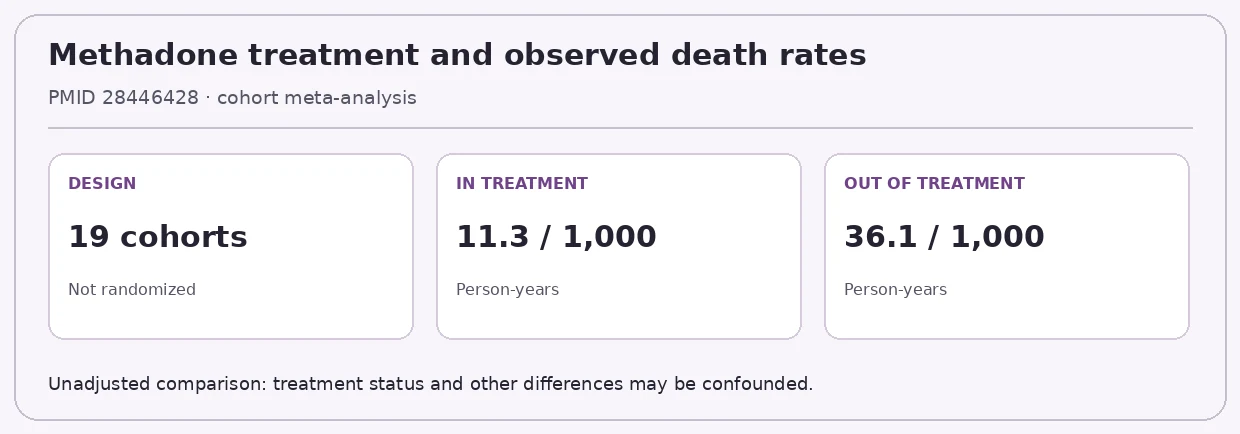
The comparison was observational: death rates recorded during follow-up periods in treatment versus out of treatment, not a randomized trial. Pooled all-cause mortality was 11.3 per 1000 person years in methadone treatment and 36.1 out of it, an unadjusted out-to-in rate ratio of 3.20 (95% confidence interval 2.65 to 3.86). Overdose mortality followed a similar pattern: 2.6 versus 12.7 per 1000 person years for methadone (4.80, 2.90 to 7.96).
Trust is limited because these are cohort comparisons. The authors state further research must properly account for potential confounding and selection bias. The abstract does not report randomization, blinding, or how individual studies handled confounders. It also notes mortality was elevated during methadone induction and shortly after leaving either treatment.
A useful interpretive question: were the people observed out of treatment similar to those in treatment, or did differences in health, circumstances, or care-seeking drive part of the gap? Because the design is observational, these associations should not be read as proven causal effects.
Review: PMID 28446428 · DOI 10.1136/bmj.j1550
Написать Join — чтобы участвовать в обсуждении.