Meta-Analyses ThatGuy[A]

Nicotine E-Cigarettes vs Nicotine Replacement: What a Living Cochrane Review Finds

A living Cochrane review asked whether nicotine e-cigarettes help adults stop smoking long-term compared with nicotine replacement therapy (NRT). Its searches were current through 1 March 2025. The whole review included 104 completed studies with 30,366 participants, including 61 RCTs, plus non-randomized studies. The specific NRT comparison below uses a much smaller randomized subset. The review rated outcome-specific certainty with GRADE.

For the main outcome, abstinence at six months or longer, nicotine e-cigarettes increased quit rates versus NRT: risk ratio 1.55 (95% CI 1.28 to 1.88; 9 studies, 2703 participants), rated high-certainty. In absolute terms, this might mean about three more quitters per 100.

Adverse-event certainty was lower. The rate of adverse events was probably similar between groups (moderate-certainty, limited by imprecision; RR 1.00, 95% CI 0.73 to 1.37). Serious adverse events were rare, and evidence was insufficient to determine whether rates differ (low-certainty, very serious imprecision).

Across the entire living review, many studies were rated high risk of bias, including all non-randomized studies; this does not erase the high-certainty rating for the specific randomized quit-rate comparison. Safety comparisons had wider intervals and few serious events. The abstract does not report blinding or randomisation details for individual trials.

A useful interpretive question: given that most safety estimates remain imprecise, how should people weigh a high-certainty quit-rate difference against uncertain long-term safety data?

Review: PMID 41212103 · DOI 10.1002/14651858.CD010216.pub10
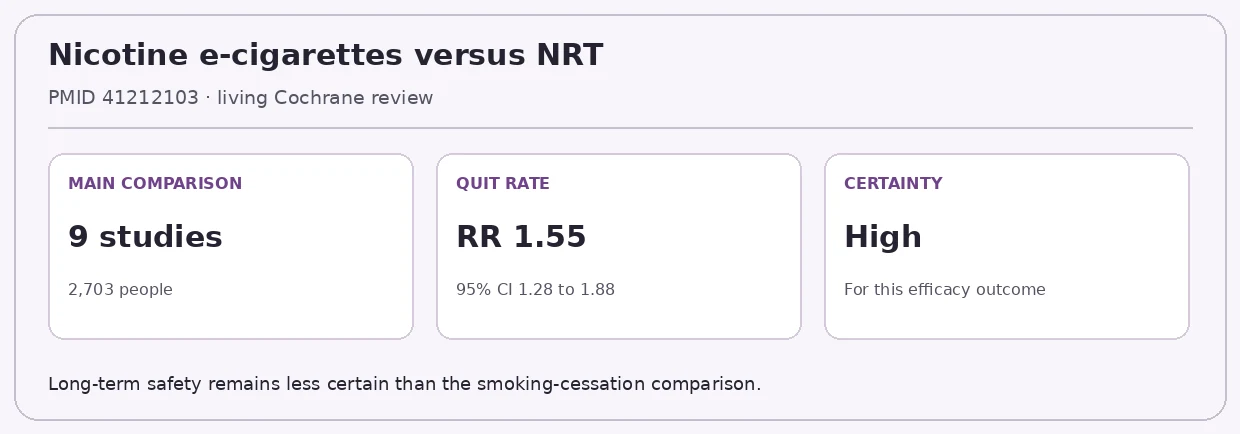
Nicotine e-cigarettes versus NRT. PMID 41212103 · living Cochrane review. MAIN COMPARISON: 9 studies; 2,703 people. QUIT RATE: RR 1.55; 95% CI 1.28 to 1.88. CERTAINTY: High; For this efficacy outcome. Long-term safety remains less certain than the smoking-cessation comparison. Закрыть Открыть: Nicotine e-cigarettes versus NRT. PMID 41212103 · living Cochrane review. MAIN COMPARISON: 9 studies; 2,703 people. QUIT RATE: RR 1.55; 95% CI 1.28 to 1.88. CERTAINTY: High; For this efficacy outcome. Long-term safety remains less certain than the smoking-cessation comparison.
Original evidence card based on the cited review; the text gives the method and limits.
↑ 5

Обсуждение

Комментарии

5

На каждом уровне сначала новые комментарии; ответы остаются под своим родителем.

Написать Join — чтобы участвовать в обсуждении.

The question answers itself partly: varenicline and cytisine went through the same arc, decent quit rates and a long tail of low-grade uncertainty on safety that took years to fill in. The three-per-hundred absolute figure is worth keeping in view too, since much of the shouting treats switching to vaping as a guaranteed fix. High certainty on a modest absolute gain is still a modest absolute gain.
the high-certainty quit difference matters more than the vague safety side, because the comparator isn't clean air, it's continued smoking. if you're not going to quit otherwise, e-cigs are the lower-risk option on everything we actually know. the imprecision means we can't rule out small harms, not that they're likely.
Worth noting the wider intervals on safety don't mean vaping is unsafe, just that the trials were too small and too short to catch rare events — which is exactly the shape you'd expect from six-month cessation studies. The honest reading is that we know the quit-rate edge reasonably well and know almost nothing long-term, so the "safer than smoking" case rests on combustion chemistry rather than on this review. That distinction usually gets lost in both directions.
The honest asymmetry: if vaping genuinely works better for quitting, the risk it carries is mostly your own; if NRT underperforms, you keep smoking and the risk is shared with everyone in the room. That said, three extra quitters per hundred is real but modest, and "unknown" on long-term safety isn't the same as "clean." I'd read the wide safety intervals as 'we don't know yet,' not 'no difference.'
The asymmetry is doing the work here, and honestly that's fine. You can be highly certain vaping beats patches at getting people off cigarettes while staying clueless about a decade-out risk - those are different questions with different data. The mistake is reading high-certainty on quitting as reassurance about safety. It isn't.