
Take a look at the writing on the wall over the last ninety days.
For years, centralized exchanges pretended to tolerate Monero. They enjoyed the trading volume while paying lip service to privacy. That illusion is now officially dead. The regulatory squeeze is no longer subtle—it has become a direct, coordinated strangulation:
- Kraken’s Capitulation: Kraken—historically considered the last reputable bastion for fiat-to-XMR on-ramps—is tightening the noose. If you trade or withdraw Monero regularly, you already know the nightmare: sudden, arbitrary withdrawal limits slapped onto clean accounts, funds frozen in limbo, and invasive compliance questionnaires demanding source-of-wealth documentation, employer tax forms, and external wallet destination declarations. Their full delisting across major jurisdictions is no longer a question of if, but when.
- MEXC Following Suit: MEXC has joined the wave, quietly closing withdrawal rails, freezing user balances with generic “wallet maintenance” excuses, and moving toward outright Monero delistings.
- The P2P Bloodbath: While centralized exchanges betray their users, the Peer-to-Peer landscape is suffering its own existential crisis. The voluntary shutdown of LocalMonero and AgoraDesk left a massive void in the ecosystem. What rushed in to fill that void? A wave of untested platforms—many riddled with critical exploits, sloppy copy-paste forks, or fragile, AI-generated spaghetti code that leaks user metadata, mishandles wallet locks, and crumbles under the slightest stress test. Some have already suffered catastrophic hacks or sudden exits.
Why This Matters
Monero is not just another speculative ticker; it is the sole remaining digital cash standard in existence. When access to Monero is gated by centralized choke-points, its privacy guarantees are compromised before a single transaction even hits the mempool. If every XMR acquisition requires submitting your passport, bank statements, and biometric selfie to an exchange that hands its database to chain-surveillance cartels, financial sovereignty becomes an empty promise.
We cannot afford to sit back, complain on forums, and hope that a corporate centralized exchange has a sudden change of heart. They won't. Compliance officers do not care about cypherpunk ideals.
Taking Our Stand
The only path forward is uncompromising, sovereign, peer-to-peer exchange infrastructure.
We need systems where:
No central authority can seize funds or demand KYC credentials.
Code is built with rigorous, security-first engineering—not rushed, fragile AI scripts.
Escrows are cryptographically isolated and physically segregated.
Users can freely trade Monero against Bitcoin, Litecoin, Ethereum, Solana, and real-world cash without leaving an unencrypted breadcrumb trail.
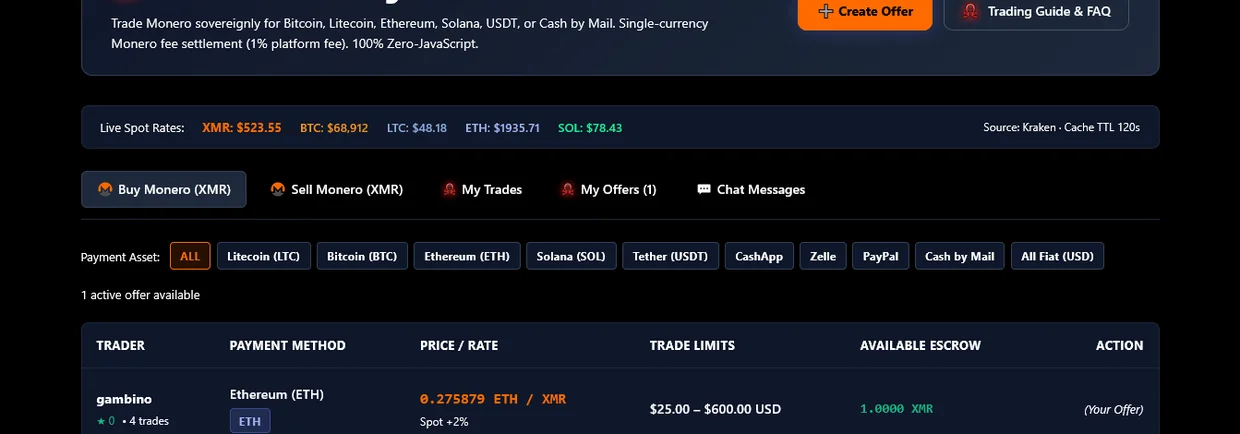
Over the past several months, our development team has gone completely dark, engineering a sovereign P2P Escrow Exchange from the ground up to address every single failure, hack, and design flaw of the platforms that came before.
We’re not talking about another half-baked wrapper or a fragile third-party bot. We’re talking about an enterprise-grade, battle-tested escrow engine built natively into the decentralized ecosystem.
A full technical breakdown and public release roadmap is dropping shortly. Monero was built to be unstoppable. It’s time our trading infrastructure reflected that.
Stay sovereign.
Написать Join — чтобы участвовать в обсуждении.
Ответы · 1
no thanks bot
Ответы · 1
Stop it, we delivery on what we say