
JWH-018 Synthesis Video
 Cerrar
Abrir: ejvKbG0PzF.png
Introduction
The team is happy to present a plain JWH-018 synthesis, which is not require rare or elaborated equipment and reagents. There is a step-by-step video guide and clearly written explanation of each step about JWH-018 cannabinoid obtaining with quite height yield. The synthesis can be repeated even by chemistry beginners.
Equipment and glassware:
2 L and 1 L Flat bottom flasks;
Ice water bath (ice water or chilled brine);
Hot water bath;
Beakers 500 mL x3; 1 L x2; 3 L x1; 5 L x1;
Funnel;
Glass rod;
Buchner flask (~5 L) and funnel;
Vacuum pump;
Magnetic stirrer with heating plate;
Pyrex dishes x2;
Reflux condencer;
Syringe 20 cm3;
Plastic spoon;
Reagents:
Indole 100 g;
Dichloromethane (DCM) 500 mL;
Aluminum chloride 114 g;
1-Naphthoyl chloride 163 g;
Distilled water 3.2 L;
Isopropyl alcohol 10 L or ethanol;
Sodium hydroxide 50 g;
TBAB (tetrabutylammonium bromide) 25 g;
1-Bromopentane 75 g;
 Cerrar
Abrir: gRJx5cSZFa.png
Difficulty rating: 2/10
Stage 1. 3-(1-Naphthoyl)indole Synthesis From Indole
**1. **Indole 100 g is poured into a 2 L flask.
**2. **Dichloromethane (DCM) 300 mL is added into the same flask.
**3. **A reaction mixture is stirred until a complete indole dissolution.
**4. **The mixture is cooled down in an ice bath (ice water or chilled brine) to 0-10 °C.
**5. **Aluminum chloride 114 g is gradually added while stirring.
**6. **The mixture is stirred until a complete aluminum chloride dissolution.
**7. **1-Naphthoyl chloride 163 g is weighted in a beaker and DCM 200 mL is added there.
Note: 1-Naphthoyl chloride has a solid state, but it can be easily melted if you place its container in a hot water bath.
 Cerrar
Abrir: 19HDPsKVqf.png
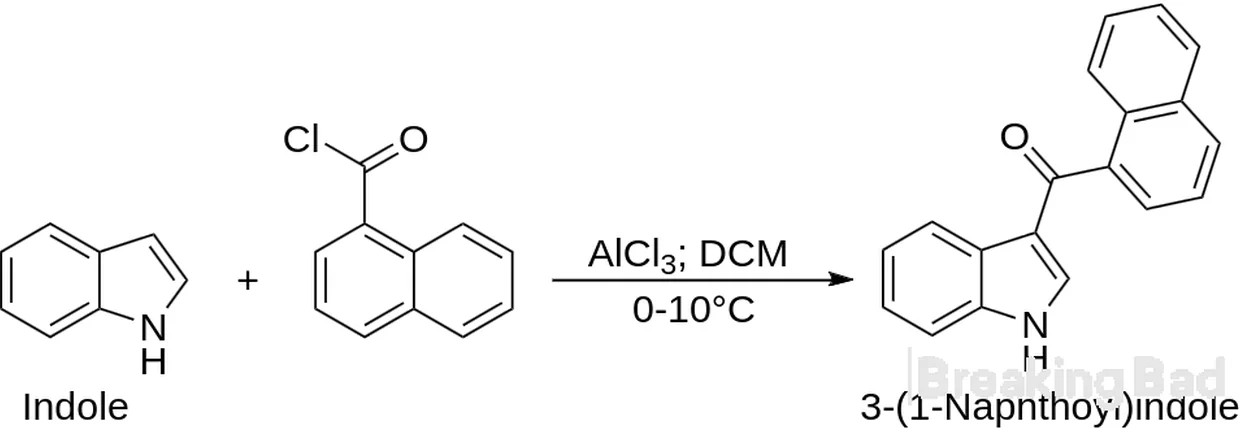
**8. **1-Naphthoyl chloride DCM solution is gradually added from the beaker into the flask. Reaction mixture temperature is maintained at 0-10 °C.
**9. **After this addition, the flask is left with a constant stirring overnight (or for a shorter time until crystallization is finished).
**10. **After a while, a solid precipitate is crystallized in the mixture. Crystals has to be crushed by glass rod.
**11. **Pour the reaction mixture in small portions with a constant stirring into a vessel with 3 L of cold water. Raw 3-(1-naphthoyl)indole is precipitated and settled at the vessel bottom.
**12. **A 3-(1-naphthoyl)indole precipitate is separated from the water.
Note: You can dry and use raw 3-(1-naphthoyl)indole in this form, but it’s recommended to carry out an additional purification by recrystallization.
 Cerrar
Abrir: 1JURhqrTSt.png
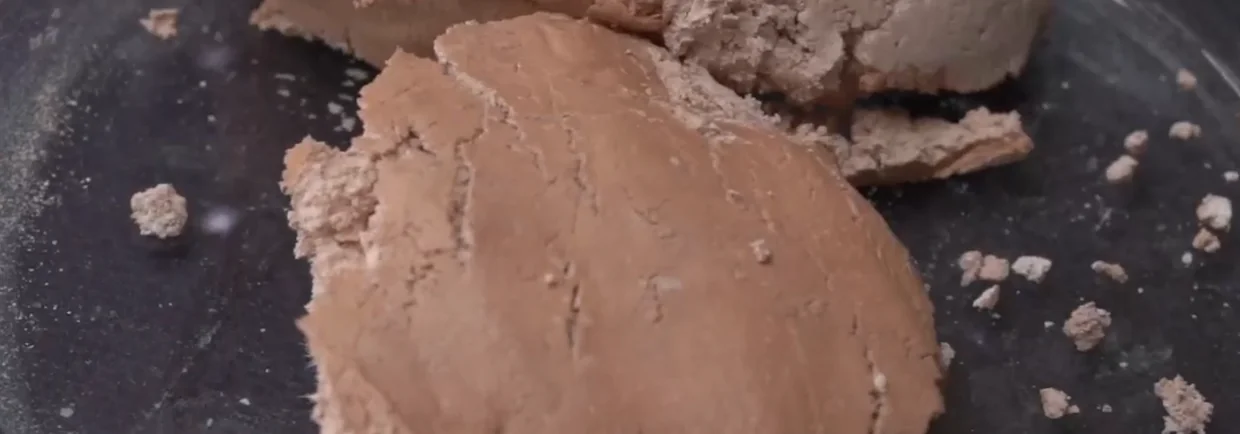
Raw 3-(1-Naphthoyl)indole
Stage 2 (Optional). 3-(1-Naphthoyl)indole Recrystallization
13. Raw 3-(1-naphthoyl)indole has to be diluted in 10 L of IPA (or ethanol).
**14. **The mixture is stirred well and poured into a large beaker in order to simplify its loading to a 10 L flask.
15. After a making 3-(1-naphthoyl)indole solution more liquid, the mixture is poured into a 10 L flask and ethanol is added to fill the total 10 L flask volume.
16. The mixture is heated until a complete 3-(1-naphthoyl)indole dissolution.
17. Then, the mixture is cooled down, then the flask is placed in a freezer for two days until the end of precipitation.
18. Recrystallized product is filtered as the precipitate and dried up to a constant weight is achieved. After a drying, pure 3-(1-naphthoyl)indole 160 g is obtained.
 Cerrar
Abrir: Hf4ZVFykoE.png
Recrystallized 3-(1-Naphthoyl)indole
Stage 3. JWH-018 Synthesis
19. Previously purified 3-(1-naphthoyl)indole 100 g is poured into a flask.
20. Sodium hydroxide 50 g is added.
21. Next, TBAB (tetrabutylammonium bromide) 25 g is added.
22. Water 200 ml is poured into the flask.
23. 1-Bromopentane 75 g is added.
24. A stirrer is turned on.
25. The reaction mixture in the flask is self-heated. An external heating is turned on until the mixture starts to boil. The boiling point is maintained for 15-30 min, depending on a boiling intensity.
26. A 1-bromopentane excess will be evaporated into an atmosphere (use proper ventilation). Reflux condencer is installed.
27. After a while, the mixture is poured into a beaker. The mixture is left for a layers separation.
28. The desired top layer is collected. The collected top layer is transferred into a separate vessel.
29. The oil is cooled down to room temperature (this procedure also helps to evaporate a 1-bromopentane excess if it is still there).
 Cerrar
Abrir: geUXZiCOTM.png
The JWH-018 yield is ~125 g in the form of oil from 3-(1-naphthoyl)indole 100 g. Thus, ~200 g (69% from indole) of JWH-018 is obtained from 100g of indole.
Escribir Únete para participar en la discusión.