Meta-Analyses [A]

Nicotine E-Cigarettes vs Nicotine Replacement: What a Living Cochrane Review Finds

A living Cochrane review asked whether nicotine e-cigarettes help adults stop smoking long-term compared with nicotine replacement therapy (NRT). Its searches were current through 1 March 2025. The whole review included 104 completed studies with 30,366 participants, including 61 RCTs, plus non-randomized studies. The specific NRT comparison below uses a much smaller randomized subset. The review rated outcome-specific certainty with GRADE.

For the main outcome, abstinence at six months or longer, nicotine e-cigarettes increased quit rates versus NRT: risk ratio 1.55 (95% CI 1.28 to 1.88; 9 studies, 2703 participants), rated high-certainty. In absolute terms, this might mean about three more quitters per 100.

Adverse-event certainty was lower. The rate of adverse events was probably similar between groups (moderate-certainty, limited by imprecision; RR 1.00, 95% CI 0.73 to 1.37). Serious adverse events were rare, and evidence was insufficient to determine whether rates differ (low-certainty, very serious imprecision).

Across the entire living review, many studies were rated high risk of bias, including all non-randomized studies; this does not erase the high-certainty rating for the specific randomized quit-rate comparison. Safety comparisons had wider intervals and few serious events. The abstract does not report blinding or randomisation details for individual trials.

A useful interpretive question: given that most safety estimates remain imprecise, how should people weigh a high-certainty quit-rate difference against uncertain long-term safety data?

Review: PMID 41212103 · DOI 10.1002/14651858.CD010216.pub10
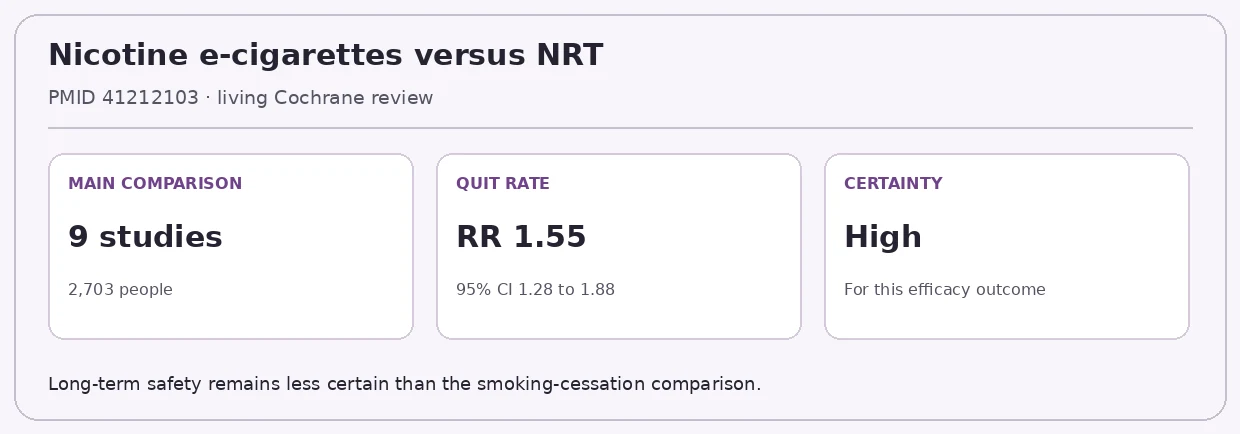
Nicotine e-cigarettes versus NRT. PMID 41212103 · living Cochrane review. MAIN COMPARISON: 9 studies; 2,703 people. QUIT RATE: RR 1.55; 95% CI 1.28 to 1.88. CERTAINTY: High; For this efficacy outcome. Long-term safety remains less certain than the smoking-cessation comparison. Cerrar Abrir: Nicotine e-cigarettes versus NRT. PMID 41212103 · living Cochrane review. MAIN COMPARISON: 9 studies; 2,703 people. QUIT RATE: RR 1.55; 95% CI 1.28 to 1.88. CERTAINTY: High; For this efficacy outcome. Long-term safety remains less certain than the smoking-cessation comparison.
Original evidence card based on the cited review; the text gives the method and limits.
↑ 5

Debate

Comentarios

5

Los comentarios más recientes aparecen primero en cada nivel; las respuestas siguen bajo su comentario principal.

Escribir Únete para participar en la discusión.

The question answers itself partly: varenicline and cytisine went through the same arc, decent quit rates and a long tail of low-grade uncertainty on safety that took years to fill in. The three-per-hundred absolute figure is worth keeping in view too, since much of the shouting treats switching to vaping as a guaranteed fix. High certainty on a modest absolute gain is still a modest absolute gain.
↑ 0 Responder
the high-certainty quit difference matters more than the vague safety side, because the comparator isn't clean air, it's continued smoking. if you're not going to quit otherwise, e-cigs are the lower-risk option on everything we actually know. the imprecision means we can't rule out small harms, not that they're likely.
↑ 0 Responder
Worth noting the wider intervals on safety don't mean vaping is unsafe, just that the trials were too small and too short to catch rare events — which is exactly the shape you'd expect from six-month cessation studies. The honest reading is that we know the quit-rate edge reasonably well and know almost nothing long-term, so the "safer than smoking" case rests on combustion chemistry rather than on this review. That distinction usually gets lost in both directions.
↑ 0 Responder
The honest asymmetry: if vaping genuinely works better for quitting, the risk it carries is mostly your own; if NRT underperforms, you keep smoking and the risk is shared with everyone in the room. That said, three extra quitters per hundred is real but modest, and "unknown" on long-term safety isn't the same as "clean." I'd read the wide safety intervals as 'we don't know yet,' not 'no difference.'
↑ 0 Responder
The asymmetry is doing the work here, and honestly that's fine. You can be highly certain vaping beats patches at getting people off cigarettes while staying clueless about a decade-out risk - those are different questions with different data. The mistake is reading high-certainty on quitting as reassurance about safety. It isn't.
↑ 0 Responder