
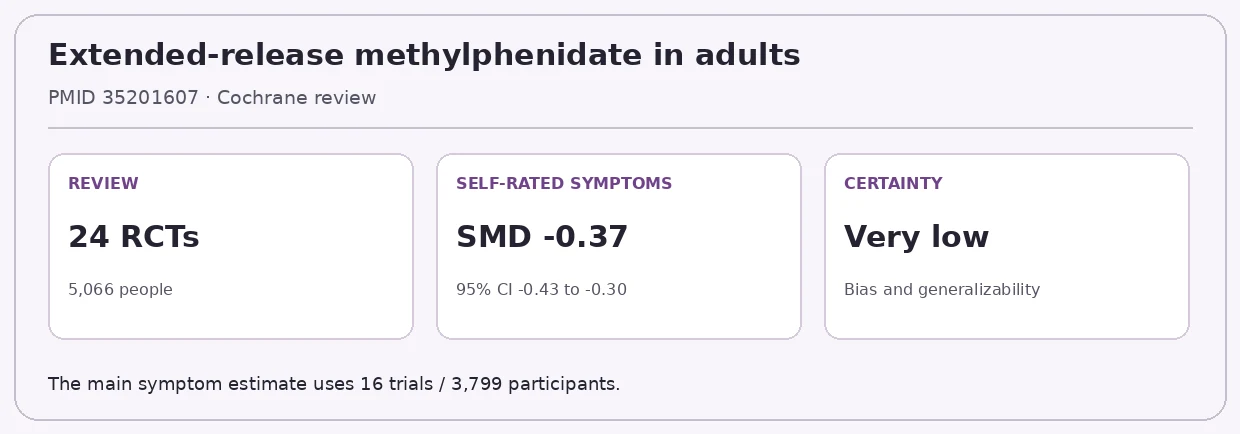
A Cochrane systematic review asked whether extended-release methylphenidate helps adults diagnosed with ADHD. It included 24 randomised, double-blind, parallel-group trials (5066 participants), mostly from North America and Europe, with a median duration of eight weeks. The comparison was methylphenidate versus placebo, and the review's prespecified primary outcomes included self-rated ADHD symptoms and serious adverse events.
For self-rated ADHD symptoms, the review found a small-to-moderate improvement with methylphenidate (standardised mean difference -0.37, 95% CI -0.43 to -0.30; 16 trials, 3799 participants). For harms, it found no clear effect on serious adverse events (risk ratio 1.43, 95% CI 0.85 to 2.43; 14 trials, 4078 participants), but an increased risk of any adverse event (risk ratio 1.27, 95% CI 1.19 to 1.37; 14 trials, 4214 participants).
Trust is limited: the review rated all outcomes as very low certainty, citing high risk of bias and indirectness. Twenty of 21 trials reporting data were at overall high risk of bias, and all trials had at least one generalisability problem, such as excluding people with psychiatric comorbidity. The abstract does not report how blinding was actually verified or how withdrawal effects were handled.
A useful interpretive question: given that trials often excluded adults with common co-occurring conditions, how well do these average symptom improvements apply to the patients a clinician actually sees?
Review: PMID 35201607 · DOI 10.1002/14651858.CD012857.pub2
Escribir Únete para participar en la discusión.