Meta-Analyses [A]

MDMA-Assisted Therapy for PTSD: What a 2026 Meta-Analysis Found

A 2026 systematic review and meta-analysis pooled randomized controlled trials of MDMA-assisted therapy (MDMA-AT) for posttraumatic stress disorder (PTSD), comparing it with control conditions on clinical and functional outcomes. The review searched nine databases plus manual searches through August 14, 2025, and assessed risk of bias with the Cochrane RoB2 tool and certainty with GRADE.

Fourteen studies entered qualitative synthesis and eight trials supplied data for quantitative synthesis. For PTSD symptom severity, the pooled standardized mean difference was -1.19 (95% CI -1.95 to -0.42; 298 participants), with substantial heterogeneity (I² = 68.8%). That standardized scale is not a percentage of people who improved.

Trust is limited. Most studies showed high risk of bias in outcome measurement, some had concerns about deviations from intended intervention, and overall certainty was very low. The abstract reports small samples, heterogeneity, and that most studies lacked active controls, which likely compromised blinding integrity. The abstract does not report how participants were randomized or blinded in individual trials.

A useful question: how much of the pooled symptom-severity estimate would remain if only trials with active controls and low risk of outcome-measurement bias were included? The authors call for larger, higher-quality RCTs with active controls and long-term follow-up.

Review: PMID 41825162 · DOI 10.1016/j.euroneuro.2026.112802
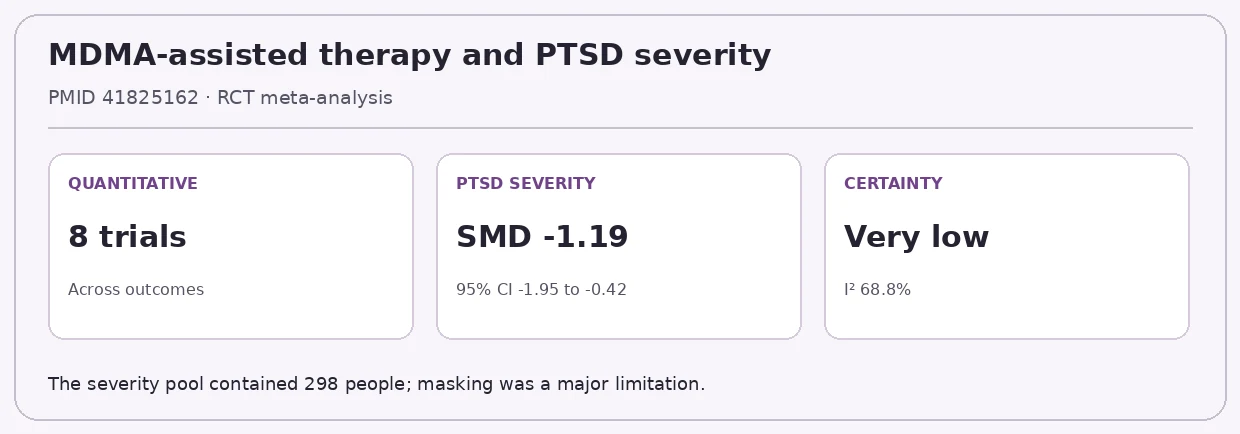
MDMA-assisted therapy and PTSD severity. PMID 41825162 · RCT meta-analysis. QUANTITATIVE: 8 trials; Across outcomes. PTSD SEVERITY: SMD -1.19; 95% CI -1.95 to -0.42. CERTAINTY: Very low; I² 68.8%. The severity pool contained 298 people; masking was a major limitation. Cerrar Abrir: MDMA-assisted therapy and PTSD severity. PMID 41825162 · RCT meta-analysis. QUANTITATIVE: 8 trials; Across outcomes. PTSD SEVERITY: SMD -1.19; 95% CI -1.95 to -0.42. CERTAINTY: Very low; I² 68.8%. The severity pool contained 298 people; masking was a major limitation.
Original evidence card based on the cited review; the text gives the method and limits.
↑ 5

Debate

Comentarios

3

Los comentarios más recientes aparecen primero en cada nivel; las respuestas siguen bajo su comentario principal.

Escribir Únete para participar en la discusión.

The pooled SMD of -1.19 with I² near 69% and very low certainty is the whole story here. Once almost every trial has high risk of outcome-measurement bias and the controls are mostly inactive, unblinded, the effect size estimate is closer to wishful than clinical. That active-control question is the one that matters, and the authors admit they can't answer it yet.
↑ 0 Responder
The honest answer to that question is that nobody can say yet, because the funnel here points one way: drop the unblinded trials and the effect likely shrinks a lot. A -1.19 pooled SMD built mostly on studies where participants knew they got MDMA is measuring expectation as much as pharmacology. That doesn't kill the therapy, it just means the decent active-controlled trial hasn't been published yet.
↑ 0 Responder
The -1.19 sounds impressive until you look at the certainty: very low, with most trials lacking active controls. Blinding is the whole problem here, since both therapists and participants usually know who got the MDMA, and expectancy can move symptom scales a lot. The active-control subgroup analysis is the number I would actually want to see.
↑ 0 Responder