Introduction
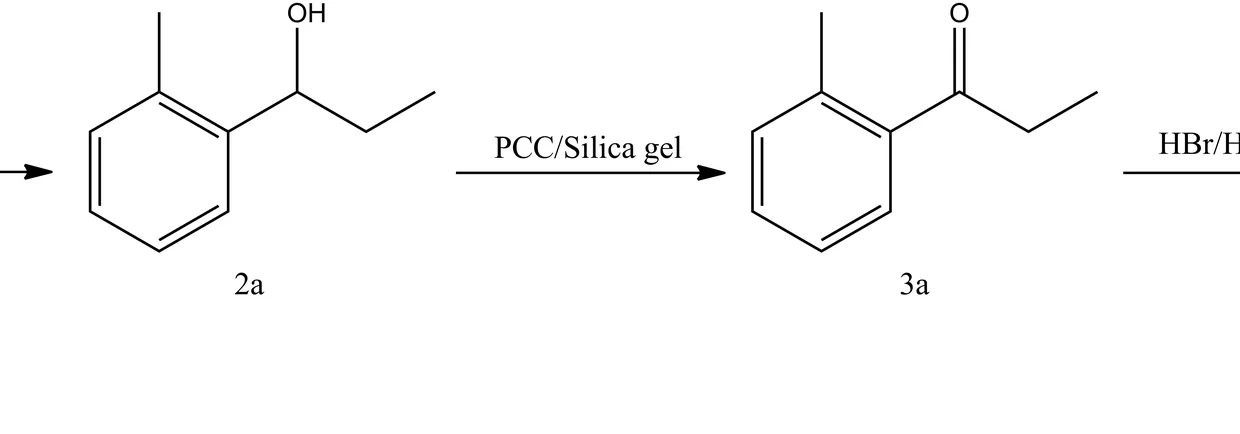
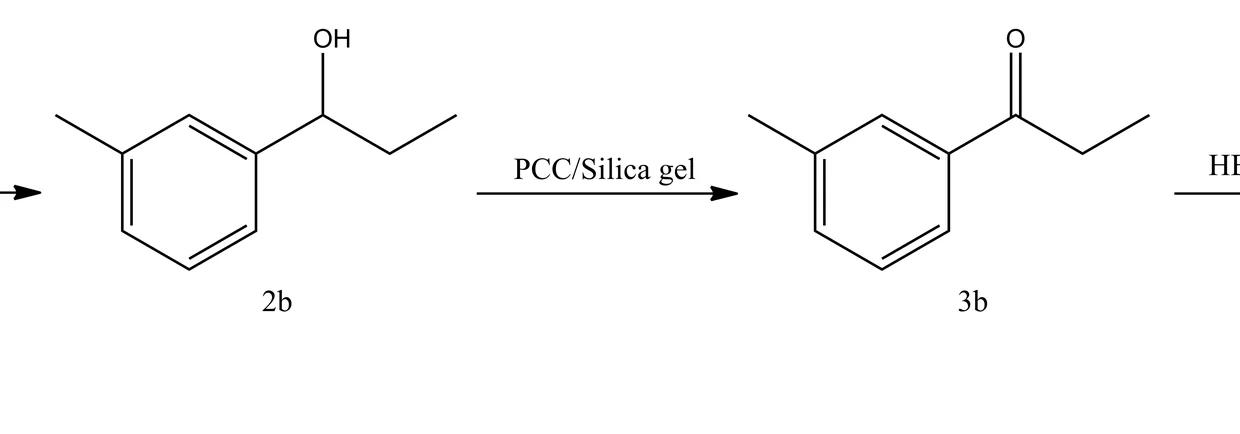
2-Bromo-2'-methylpropiophenone and 2-bromo-3'-methylpropiophenone were synthesized as outlined in schemes below. Reaction of the respective methylbenzaldehyde (1a, b) with ethyl magnesium bromide, followed by oxidation with pyridinium chlorochromate (PCC) on silica gel and bromination with hydrobromic acid/hydrogen peroxide afforded the lachrymatory bromo ketones 4a and 4b, which can be used without further purification for syntheses of 2-MMC and 3-MMC.
Equipment and glassware:
Three-necked round bottom flask 250 ml;
Pressure equalized drip funnel;
Retort stand and clamp for securing apparatus;
Magnetic stirrer;
Beakers 250 mL x3; 100 mL x2;
Nitrogen balloon (optional, but recommended);
Rotovap apparatus;
Glass rod and spatula;
Ice bath;
Laboratory scale;
Measuring cylinder 50 mL;
Reagents:
2-Methylbenzaldehyde 1a or 3-Methylbenzaldehyde 1b (4.2 g; 35 mmol);
Tetrahydrofuran (THF) 40 ml;
Ethyl magnesium bromide 3 M (8g; 60 mmol) in diethyl ether 20 ml;
Distilled water;
Aqueous hydrochloric acid (HCl aq) 2 M (6.66%);
Dichloromethane (DCM) ~200 ml;
Anhydrous magnesium sulphate (MgSO4);
Pyridinium chlorochromate on silica gel (34 g, 33% PCC);
Concentrated aqueous hydrobromic acid (Hbr aq 48 wt.%, 7.3 ml, 64 mmol);
2-Bromo-2'-methylpropiophenone (4a) and 2-Bromo-3'-methylpropiophenone (4b) Synthesis
1. A solution of aldehyde 1a or 1b (4.2 g; 35 mmol) in THF (20 ml) was added slowly to a mixture of ethyl magnesium bromide (3 M in diethyl ether, 20 ml, 60 mmol) and THF (20 ml) under nitrogen at room temperature in 250 ml tree-necked round bottom flask.
2. The mixture was allowed to stir overnight at room temperature.
3. Excess Grignard reagent was decomposed by the cautious addition of water and the mixture was evaporated to dryness under vacuum.
4. The residue was partitioned between 2 M aqueous hydrochloric acid and dichloromethane.
5. Drying (MgSO4) and removal of solvent afforded colourless oil, which was dissolved in dichloromethane (100 ml) in the same (clean) 250 ml round bottom flask.
6. This was added to pyridinium chlorochromate on silica gel (34 g, 33% PCC).
7. The mixture was allowed to stir overnight at room temperature and the solvent was removed to afford an almost colourless oil to which concentrated aqueous hydrobromic acid (48 wt.%, 7.3 ml, 64 mmol) was added.
8. The mixture was cooled in an ice bath and, with vigorous stirring, hydrogen peroxide (30 wt.%, 6.6 ml, 64 mmol) was added over 20 min.
9. The mixture was allowed to warm to room temperature, left stirring overnight and worked up by extraction into dichloromethane, drying (MgSO4) and evaporation to give a yellow oil: 2-bromo-1-(2-methylphenyl)propan-1-one (4a, 84% yield from 1a) and 2-bromo-1-(3-methylphenyl)propan-1-one (4b, 89% yield from 1b).
These were used without further purification.
Source
Power, John D., et al. "The analysis of substituted cathinones. Part 1: chemical analysis of 2-, 3-and 4-methylmethcathinone." Forensic science international 212.1-3 (2011): 6-12. https://doi.org/10.1016/j.forsciint.2011.04.020
Источник: http://bbzzzsvqcrqtki6umym6itiixfhni37ybtt7mkbjyxn2pgllzxf2qgyd.onion/threads/syntheses-of-brominated-2-and-3-methylpropiophenones.10645/

Написать Join — чтобы участвовать в обсуждении.