
Methiopropamine (MPA) Synthesis
 Закрыть
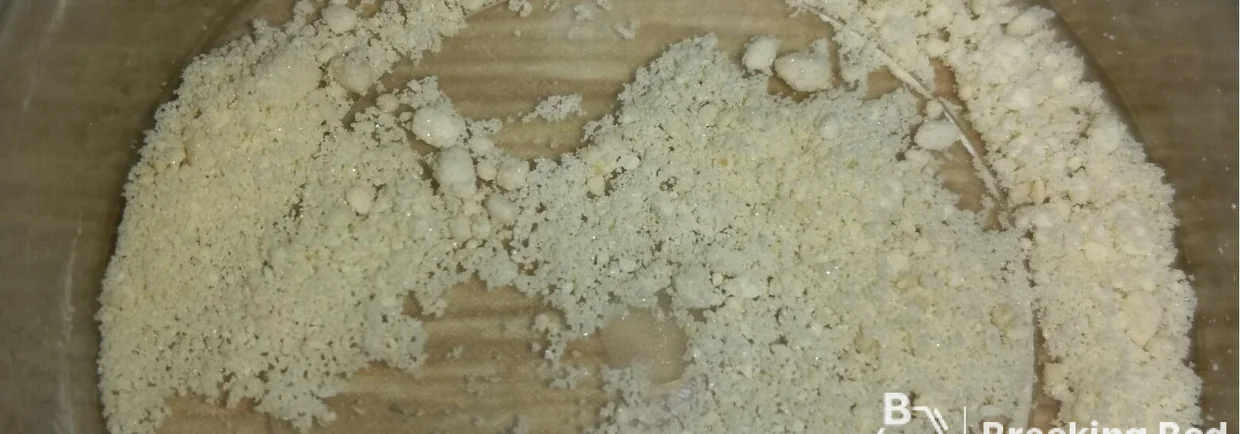
Открыть: Methiopropamine (MPA) Hydrochloride Powder
Introduction
Methiopropamine (MPA), formally known as 1-(2-thienyl)-2-(methylamino)propane, is a thiophene-based analogue of methamphetamine. It first became publicly available in the United Kingdom in December 2010, marketed as a “research chemical” or “legal high” under the brand name Blow. The methiopropamine (MPA) hydrochloride CAS 7464-94-0 synthesis process typically involves three key stages: formation of 1-(2-thienyl)-2-nitropropene, reduction to 1-(2-thienyl)propan-2-one, and reductive amination to yield the target compound in its hydrochloride salt form. This synthesis requires common organic chemistry laboratory apparatus, precise handling of reagents, and adherence to controlled reaction conditions to ensure optimal yields and purity. The following procedure outlines the simplest synthetic route adapted from established literature, emphasizing the stepwise transformations and purification method employed to obtain high-quality MPA hydrochloride suitable for recreational and analytical use.
Difficulty rating: 4/10
Equipment and glassware:
Two-necked round bottom flasks 250 ml, 500 ml;
Reflux condenser;
Magnetic stirrer with heating plate;
Funnel;
Spatula;
Glass rod;
Laboratory scale (0.01 g-200 g is suitable);
Measuring cylinders 100 ml, 20 ml and 5 ml;
Beakers 1 L; 500 ml x2; 100 ml x4; 50 ml x3;
Pipette;
Drip funnel 100 ml (optional);
Laboratory grade thermometer (10 °C to 150 °C) with flask adapter;
Retort stand and clamp for securing apparatus;
Separating funnel 1000 ml;
pH indicator papers;
Pyrex dish or similar;
Buchner flask and funnel;
Vacuum pump;
Rotary evaporator (optional);
Reagents:
Thiophene-2-carboxaldehyde 17.7 g, 0.158 mol [CAS 98-03-3];
Nitroethane 32 ml, 0.45 mol;
n-Butylamine 18 ml;
Iron powder 25 g, 0.45 mol;
Acetic acid 90% 295 ml;
Distilled water 510 ml;
Dichloromethane (DCM) 315 ml;
Saturated aqueous sodium bicarbonate solution (NaHCO3 aq);
Magnesium sulphate (MgSO4);
Sodium cyanoborohydride (NaBH3CN) 500 mg, 8 mmol;
Ethanolic methylamine 8 M (32.9% wt. %), 30 ml, 0.24 mol;
Methanol (30 ml);
Aqueous Hydrochloric Acid (HCl) 2M or ~7%;
Ethereal Hydrochloric Acid (HCl) 2M or ~7%;
 Закрыть
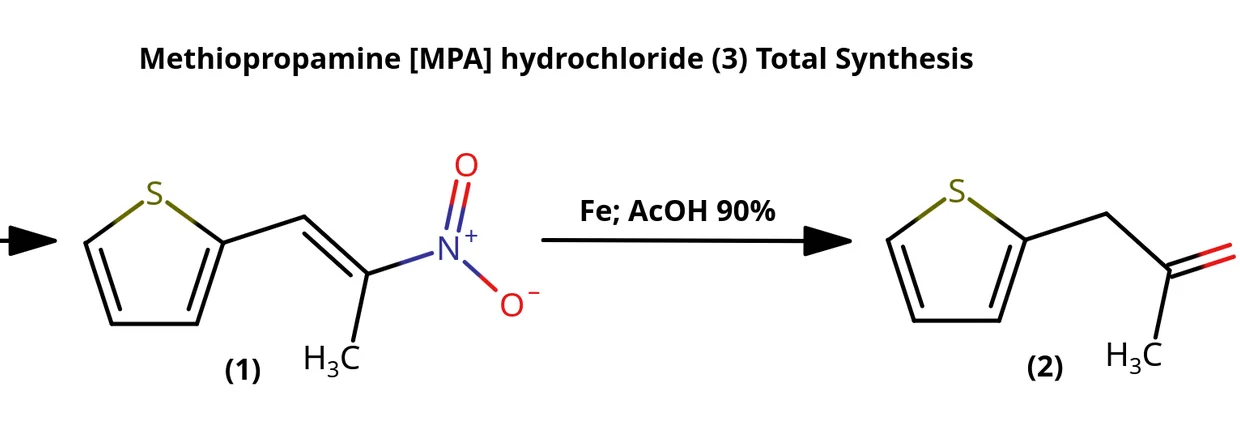
Открыть: Methiopropamine (MPA) Total Synthesis
Methiopropamine (MPA) Hydrochloride Synthesis Steps
1-(2-Thienyl)-2-nitropropene (1) Synthesis
1. Thiophene-2-carboxaldehyde (17.7 g, 0.158 mol), nitroethane (32 ml, 0.45 mol), n-butylamine (18 ml), and acetic acid (90%, 80 ml) are placed into a 250 ml two-necked round bottom flask with a magnetic stirrer bar.
2. The mixture was heated at 80 ◦C for 1 h with constant stirring (magnetic stirrer) and reflux condenser.
3. The mixture was allowed to cool and product was collected by filtration to give 1-(2-Thienyl)-2-nitropropene (1) as yellow needles (12.58 g, 0.074 mol, 47%); m.pt. 66–68 ◦C (lit. 65–67 ◦C).
 Закрыть
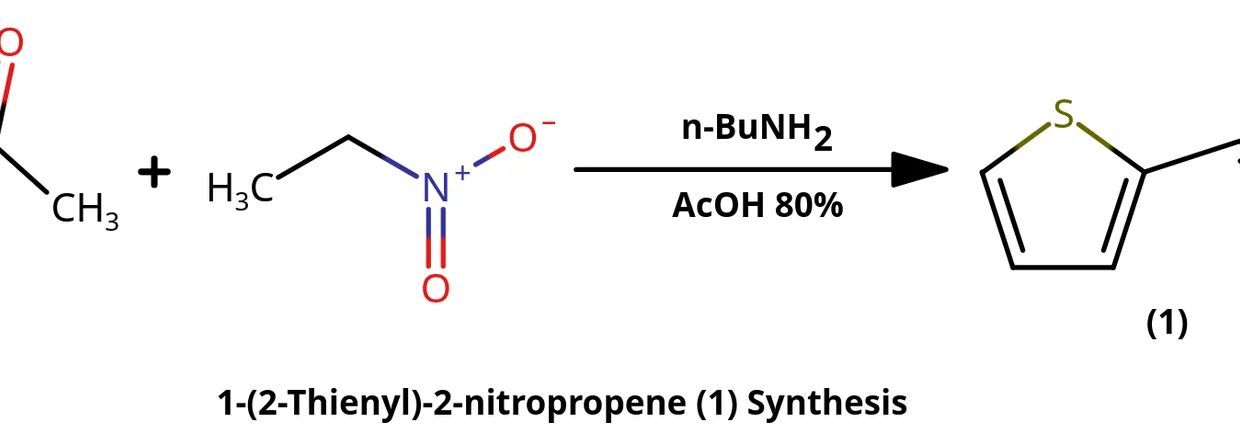
Открыть: 1-(2-Thienyl)-2-nitropropene (1) Synthesis
1-(2-Thienyl)propan-2-one (2) Synthesis
4. A mixture of iron powder (25 g, 0.45 mol) and 90% acetic acid (200 ml) was heated to 50–60 ◦C in 500 ml two-necked round bottom flask with reflux condenser.
5. 1-(2-Thienyl)-2-nitropropene (1) (6.29 g, 38 mmol) was added in several portions over approximately 5 min (with manual swirling during each addition).
6. Some effervescence was noted. The mixture was then heated (with occasional manual swirling) at 90–100 ◦C for 1 h.
7. The mixture is allowed to cool to room temperature and added to water 500 ml in 1 L separatory funnel.
8. Extraction with dichloromethane (DCM) 3 x 75 ml is carried out following by washing by saturated aqueous sodium bicarbonate (NaHCO3 aq).
**9. **The extract was dried with magnesium sulphate (MgSO4).
10. The solvent is evaporated on a rotary evaporator yielding a brown oil 1-(2-thienyl)propan-2-one (2) (3.69g, 26 mmol, 68%) which was used without further purification.
 Закрыть
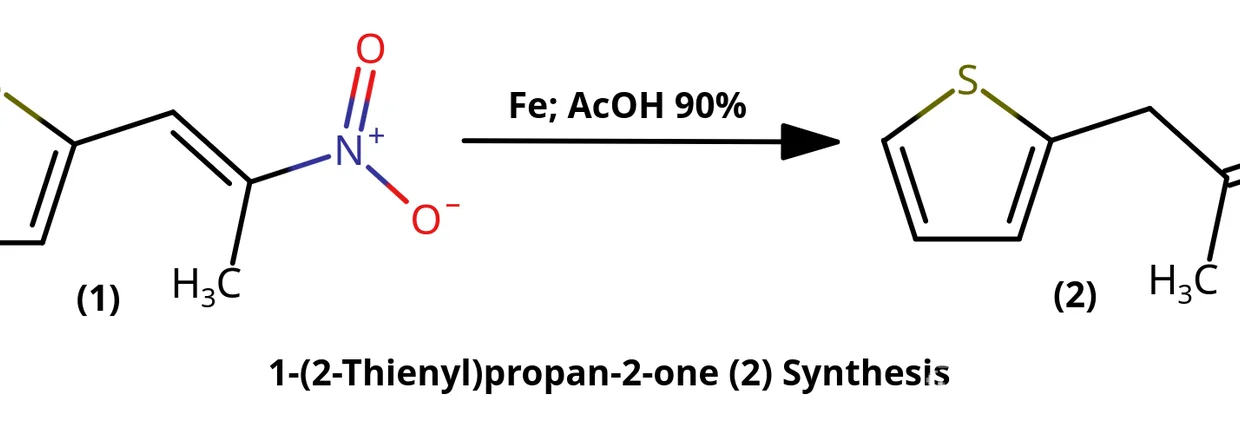
Открыть: 1-(2-Thienyl)propan-2-one (2) Synthesis
Methiopropamine [MPA; 1-(2-Thienyl)-2-(methylamino)propane] hydrochloride (3) Synthesis
11. Sodium cyanoborohydride (NaBH3CN, 500 mg, 8 mmol) was added to a mixture (adjusted to pH 6) of 1-(thiophen-2-yl)propan-2-one (2) (420 mg, 3 mmol), ethanolic methylamine (8 M, 32.9% wt. %, 30 ml, 0.24 mol), acetic acid (14.4 ml), water (10 ml) and methanol (30 ml) in a 250 ml round bottom flask.
12. The mixture was allowed to stir (magnetic stirrer) overnight at room temperature.
13. Then, the mixture is concentrated under vacuum.
14. Water was added to the residue, the solution was then basified (aqueous ammonia hydroxide solution) and extracted 3 x 30 ml into dichloromethane (DCM).
15. The dichloromethane extract was washed with aqueous hydrochloric acid (2M).
16. The acid extract was then washed with ether, basified (ammonia) and extracted into dichloromethane.
17. The extract was dried over magnesium sulphate, then the solvent was removed.
18. The hydrochloride salt is formed by ethereal 2M HCl acidification to pH 6.
19. An off white **methiopropamine [MPA] hydrochloride (3) **powder is yielded.
Purification of Methiopropamine [MPA] hydrochloride (3)
Methiopropamine [MPA] hydrochloride (3) CAS 7464-94-0 was recrystallized from ethanol/acetone, the resulting product was suspended in acetone and sonicated. The mixture was centrifuged (2000 rpm, g, 5 min, room temperature) to afford a white powder (185 mg, 0.97 mmol, 32%). m. pt. 131–3 ◦C (lit. 133–5 ◦C).
Conclusion
The synthesis of methiopropamine (MPA) hydrochloride CAS 7464-94-0 can be achieved through a straightforward sequence of condensation, reduction, and reductive amination steps, each requiring careful control of temperature, pH, and reagent stoichiometry. While the outlined route produces MPA in moderate overall yield, subsequent recrystallization and purification steps are essential for obtaining an analytically pure final product. This method, derived from peer-reviewed sources, provides a reliable pathway for generating MPA as a reference material in forensic or toxicological studies.
Sources
Angelov, D., J. O'Brien, and P. Kavanagh. "The syntheses of 1‐(2‐thienyl)‐2‐(methylamino) propane (methiopropamine) and its 3‐thienyl isomer for use as reference standards." Drug Testing and Analysis 5.3 (2013): 145-149. https://analyticalsciencejournals.onlinelibrary.wiley.com/doi/abs/10.1002/dta.298
Research Drugs. Available at research-drugs.com
↑ 0
Написать Join — чтобы участвовать в обсуждении.