PMK Methyl Glycidate & PMK Ethyl Glycidate Synthesis
Introduction
PMK glycidates, which include both the methyl and ethyl forms, are notable compounds in organic clandestine chemistry. They are often discussed because of their role as intermediates in MDMA and its analogues synthetic pathways. PMK Methyl Glycidate and PMK Ethyl Glycidate are direct precursors to MDP2P, which, in turn, is the direct MDMA precursor. PMK glycidates can be bought on Breaking Bad Forum or be synthesized in accordance represented pathways.
PMK Methyl Glycidate Synthesis
Difficulty rating: 4/10
Equipment and glassware:
Two-necked round bottom flasks 250 ml;
Magnetic stirrer;
Funnel;
Spatula;
Glass rod;
Laboratory scale (0.01 g-200 g is suitable);
Measuring cylinders 100 ml, 20 ml and 5 ml;
Beakers 500 ml x2; 100 ml x3; 50 ml x2;
Pipette;
Laboratory grade thermometer (10 °C to 150 °C) with flask adapter;
Retort stand and clamp for securing apparatus;
Separating funnel 500 ml;
pH indicator papers;
Distillation apparatus;
Vacuum pump;
Rotary evaporator (optional);
Reagents:
Sodium ethoxide 23 g (EtONa);
Piperonal (1) 50 g;
Methyl a-bromopropionate 61 g;
Water;
Diluted 5% acetic;
Diethyl ether 225 ml;
Aqueous sodium carbonate (Na2CO3) solution 10%;
Anhydrous sodium sulphate (Na2SO4);
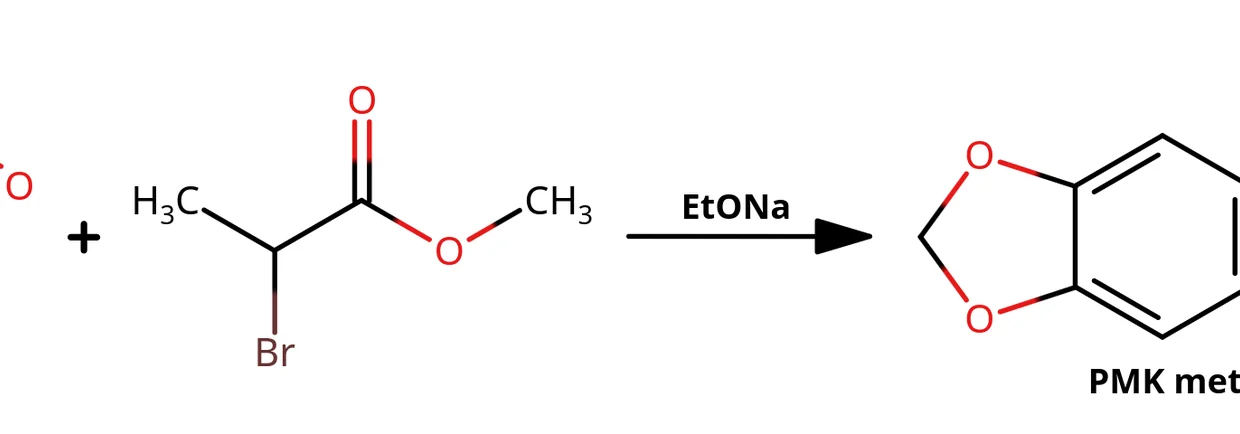
PMK Methyl Glycidate Synthesis*
PMK Methyl Glycidate Synthesis Steps
1. Freshly prepared powdered sodium ethoxide 23 g was added during 4 hours to a stirred mixture of piperonal (1) 50 g and methyl a-bromopropionate 61 g cooled in ice-salt (-18 - -15 °C) in 250 ml two-necked round bottom flask.
2. Stirring was continued overnight at room temperature and for 6 hours on the water-bath;
3. Ice-water was then added, and the mixture acidified with diluted 5% acetic acid to pH 6.
4. The glycide ester was extracted with diethyl ether 3 x 75 ml.
5. The ethereal solution washed with aqueous sodium carbonate and dried with sodium sulphate.
6. After evaporation of ether, the residue was distilled and collected between 70°C and 200°C at 20 mm Hg. Subsequent redistillation gave PMK Methyl Glycidate (methyl 3-[3',4'-(methylenedioxy)phenyl]- 2-glycidate) (2) 40g as a yellowish viscous liquid, b. p. is 184-186°C/14 mm Hg.
The total **PMK Methyl Glycidate **synthesis yield is 48%.
**Note: **Sodium methoxide and sodium ethylate can also be used instead of sodium ethoxide in the same molar ratio.
PMK Ethyl Glycidate Synthesis
**Difficulty rating: 4/10 **
Equipment and glassware:
Round bottom flasks 250 ml;
Reflux condenser;
Magnetic stirrer;
Funnel;
Spatula;
Glass rod;
Laboratory scale (0.01 g-200 g is suitable);
Measuring cylinders 100 ml, 20 ml and 5 ml;
Beakers 500 ml x2; 100 ml x4; 50 ml x3;
Pipette;
Laboratory grade thermometer (10 °C to 150 °C) with flask adapter;
Retort stand and clamp for securing apparatus;
Separating funnel 500 ml;
Vacuum pump;
Rotary evaporator (optional);
Reagents:
Piperonal (1), 3.00 g, 19.9 mmol;
Dichloromethane (DCM; CH2Cl2) 240 mL;
(Carbethoxyethylidene)triphenylphosphorane (2), 14.5 g, 40.0 mmol;
Hexane;
Ethylacetate (EtOAc);
m-Chloroperbenzoic acid 50–55% 6.2 g,17.9 mmol;
Aqueous sodium sulfite (Na2SO3) 10% 30 mL;
Saturated aqueous sodium bicarbonate solution 10-15% (NaHCO3);
Brine (NaCl) solution;
Anhydrous magnesium sulphate (MgSO4);
PMK Ethyl Glycidate Synthesis
PMK Ethyl Glycidate Synthesis Steps
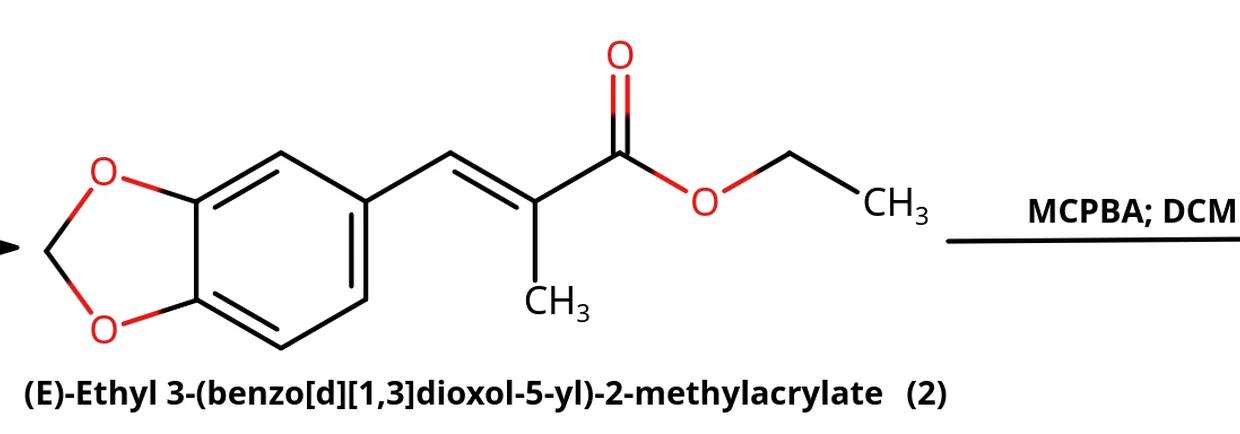
(E)-Ethyl 3-(benzo[d][1,3]dioxol-5-yl)-2-methylacrylate (2) Synthesis From Piperonal (1)
1. To a solution of piperonal (1, 3.00 g, 19.9 mmol) in CH2Cl2 (100 mL) was added (carbethoxyethylidene)triphenylphosphorane (2, 14.5 g, 40.0 mmol) in 250 ml round bottom flask.
**2. **The reaction mixture was stirred for 24 h at room temperature.
**3. **The mixture was then concentrated at reduced pressure (rotovap).
4. The residue was purified by flash column chromatography on silica gel (hexane/EtOAc,10:1) to afford olefin (E)-Ethyl 3-(benzo[d][1,3]dioxol-5-yl)-2-methylacrylate (2) 4.45 g, 95% as a colorless oil.
***(E)-Ethyl 3-(benzo[d][1,3]dioxol-5-yl)-2-methylacrylate (2) Synthesis From Piperonal (***1)
PMK Ethyl Glycidate Synthesis From (E)-Ethyl 3-(benzo[d][1,3]dioxol-5-yl)-2-methylacrylate (2)
5. To a solution of olefin (E)-Ethyl 3-(benzo[d][1,3]dioxol-5-yl)-2-methylacrylate (2, 3.00 g, 12.8 mmol) in CH2Cl2 (80 mL) was added 50–55% m-chloroperbenzoic acid (6.2 g,17.9 mmol) in 250 ml round bottom flask with reflux condenser.
**6. **The reaction mixture was refluxed for 24 h, cooled to room temperature.
**7. **Then, it is quenched with 10% aqueous sodium sulfite (30 mL), and diluted with CH2Cl2 (100 mL).
8. The organic layer was separated, and the aqueous layer was extracted with CH2Cl2 (2 × 30 mL).
9. The combined organic layers were washed with saturated aqueous NaHCO3 and brine, dried over anhydrous MgSO4, and concentrated at reduced pressure.
10. The resulting residue was purified by flash column chromatography on silica gel (hexane/EtOAc, 10:1) to afford epoxide PMK Ethyl Glycidate (3, 2.12 g, 66%) as a colorless oil.
The total **PMK Ethyl Glycidate **synthesis yield is 63%.
PMK Ethyl Glycidate Synthesis From (E)-Ethyl 3-(benzo[d][1,3]dioxol-5-yl)-2-methylacrylate
Conclusion
PMK glycidates, whether in the methyl or ethyl form, represent important intermediates in the chemistry surrounding MDP2P and its derivatives. Their role as direct precursors has made them central to discussions in both organic synthesis and regulatory control. The laboratory methods that lead to these compounds have been documented in scientific sources, and their relevance continues to be noted in clandestine chemical contexts. Because of their dual nature—scientifically valuable yet tightly regulated—they remain a notable topic within organic chemistry and its applications.
Sources
Lee, Ji Hyun, et al. "Identification of a new M-ALPHA analog and MDMA in an illegal health product." Forensic science international 313 (2020): 110332. https://www.sciencedirect.com/science/article/abs/pii/S0379073820301948
Elks, J., and D. H. Hey. "7. β-3: 4-Methylenedioxyphenyl iso propylamine." Journal of the Chemical Society (Resumed) (1943): 15-16. https://pubs.rsc.org/en/content/articlelanding/1943/jr/jr9430000015/unauth
Источник: http://bbzzzsvqcrqtki6umym6itiixfhni37ybtt7mkbjyxn2pgllzxf2qgyd.onion/threads/pmk-glycidate-synthesis.18038/

Написать Join — чтобы участвовать в обсуждении.