Amphetamine Synthesis From 2-Methyl-3-phenylpropanamide By Hofmann Rearrangement
Introduction
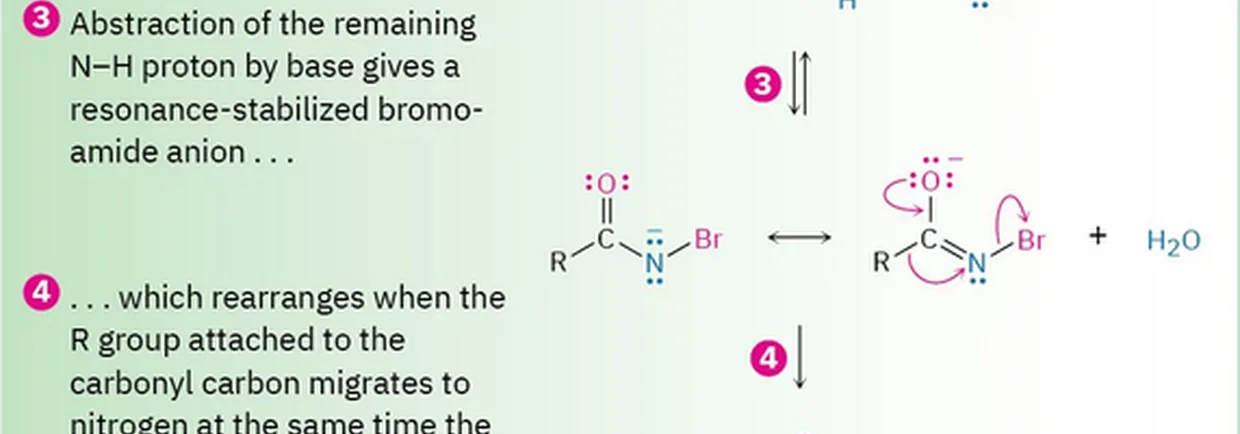
The Hofmann rearrangement is an organic reaction used to convert a primary amide to a primary amine using a halogen, base, water and heat. The reaction begins with deprotonation of the amide by the base to form an anion which then attacks the halogen to form N-haloamide. A second deprotonation by the base provides an anion that rearranges to an isocyanate intermediate and releases a halide anion. The isocyanate is then attacked by water which after a series of proton transer step results in a zwitterionic intermediate, containing ammonium cation and a carboxilate anion. Thermal conditions result in the explosion of carbon dioxide gas and quenching of ammonium cation to the amine product.
Difficulty rating: 3/10
Equipment and glassware:
Two neck round bottom flask 2 L;
Reflux condenser;
Chlorine Cl2 gas making kit [watch video];
Silicon hoses;
Ice water bath;
Magnetic stirrer with heating plate/mantle;
Funnel;
Laboratory scale (0.1 g-200 g is suitable);
Measuring cylinders 200, 100 and 20 ml;
Beakers 2 L; 500 ml x2; 100 ml x4; 50 ml x3;
Pipette;
Laboratory grade thermometer (0 °C to 100 °C) with flask adapter;
Retort stand and clamp for securing apparatus;
Separating funnel 2000 ml;
pH indicator papers;
Buchner flask and funnel;
Vacuum pump;
Rotary evaporator;
Reagents:
2-Methyl-3-phenylpropanamide 230 g [cas 7499-19-6];
Cl2 gas 109 g;
Sodium hydroxide NaOH 277 g;
Distilled water 803 ml;
Benzene 420 ml;
Concentrated hydrochloric acid (HCl 35-37%) 148 g;
Sodium hydroxide aq solution 30% (NaOH);
Amphetamine Synthesis Steps From 2-Methyl-3-phenylpropanamide
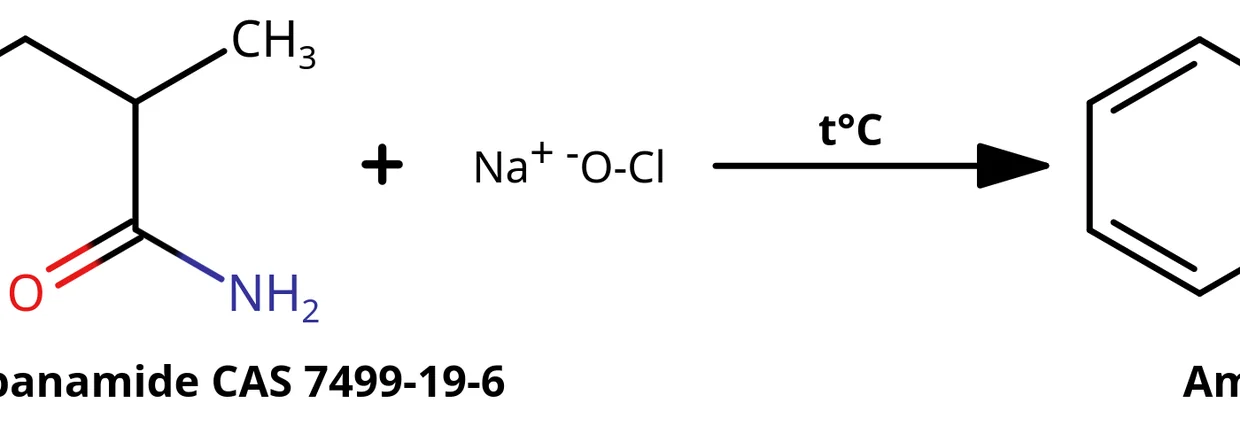
1. 2-Methyl-3-phenylpropanamide 230 g (m.p. 107-108.4°C) [cas 7499-19-6] is added to sodium hypochlorite solution in 2 L two neck round bottom flask, made by passing 109 g of Cl2 gas [watch video] into a solution of NaOH 277g in 453 ml of distilled water.
2. The reaction mixture is held at 0°C for one hour.
3. It is then slowly heated to 18°C at which point considerable heat was given off and the solid went into solution.
4. After the temperature came back under control, the solution is heated to 58°C whereupon the rearrangement occurred.
5. The heating is continued until 70°C was reached.
**6. **The solution is cooled, the oil layer is separated and the water solution is extracted with benzene using 60 ml x 3.
**7. **The benzene extract is combined with amphetamine oil and the solution is washed twice with 50 ml x 3 portions of water and 148 g of concentrated HCl acid (35-37%) slowly added to it.
**8. **The amphetamine hydrochloride acidic solution is washed twice with 30 ml benzene.
**9. **The amphetamine was then basified with NaOH 30% aq solution to pH 12.
10. The basified amphetamine is extracted from water three times with 60 ml portions of benzene.
**11. **The benzene solution is washed twice with 100 ml of water, dried over anhydrous Na2SO4 and then vacuum distilled.
Conclusion
The yield is 131 g of purified amphetamine free base [b.p. 105°C at 30 mm Hg], which is 69% of theoretical yield. Amphetamine free base can be converted into amphetamine sulphate in accordance with steps 9-12 of the method.
Source
United states patent 2,413,493 https://patents.google.com/patent/US2413493A/en
https://chem.libretexts.org/Bookshe...s_and_Heterocycles/24.06:_Synthesis_of_Amines
Источник: http://bbzzzsvqcrqtki6umym6itiixfhni37ybtt7mkbjyxn2pgllzxf2qgyd.onion/threads/amphetamine-from-2-methyl-3-phenylpropanamide.19810/

Написать Join — чтобы участвовать в обсуждении.