
The reality in 2026: MDMA is no longer just MDMA. Fentanyl contamination in the recreational drug supply has become a critical risk that your standard reagent test won't catch. Here's what you need to know before consuming.
Heading: Why fentanyl testing comes first, every time
Fentanyl is 30-50 times more potent than heroin and is now mixed into stimulants, powders, and pressed pills at scale. A Marquis reagent test will tell you if your substance contains MDMA, but it tells you nothing about whether fentanyl is also present. That's the gap that kills people.
What happens: You test positive for MDMA. You feel confident. You dose based on what you know about MDMA safety (80-120 mg). But if even a small amount of fentanyl is in that sample, your opioid tolerance (or lack thereof) becomes the variable, not the MDMA dose. Your respiratory system doesn't care about your MDMA expectations.
The step-by-step protocol
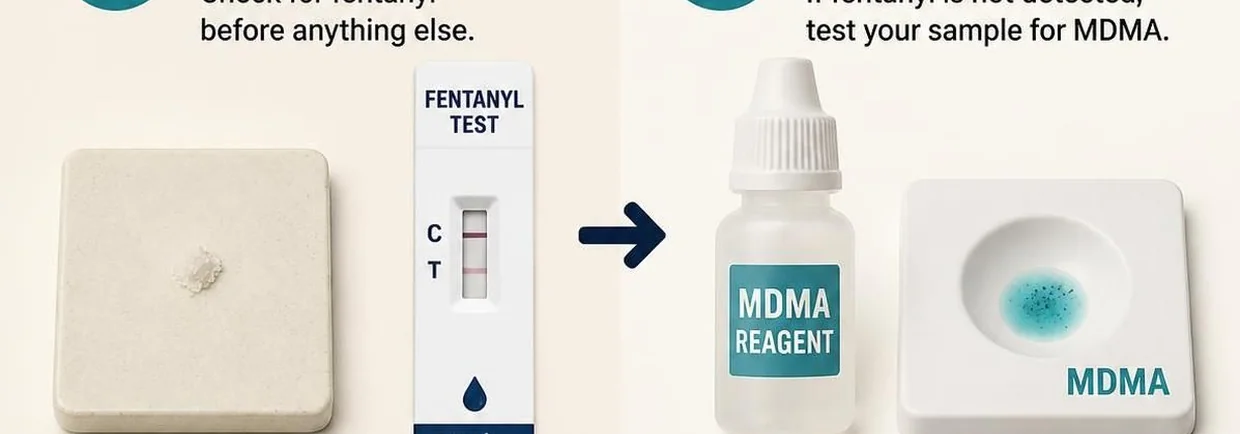
- Fentanyl test strip first - Dissolve a tiny sample in water, dip the strip, wait 15 seconds. One line = fentanyl present. Two lines = negative. If positive, your decisions change immediately.
- If negative, then reagent test - Use Marquis, Mecke, and Simon's for MDMA confirmation and to rule out substitutes like methylone or bath salts.
- Dose by weight, not faith - A calibrated milligram scale (±1 mg precision) is non-negotiable. Standard recreational dose: 1-1.5 mg per kilogram of body weight. Pre-weigh doses before the event. Pre-planning removes impulsive redosing.
- The booster trap - Clinical trials have removed booster doses in recent protocols. But recreational users still take 30-50% more MDMA 90-150 minutes in. Without medical supervision, this compounds dehydration, overheating, and serotonin depletion, especially in hot, dancing environments.
If you test positive for fentanyl
Do not use that batch. Period. If you choose to continue, which is your choice, not ours to judge, the rules change fundamentally:
- Never use alone. Someone present must have naloxone on hand and know how to use it. Start extremely low. Wait 20 seconds, assess, decide from there. Avoid redosing entirely. The risk profile shifts from "manageable pharmacology" to "overdose liability." Naloxone reverses opioid overdose for 30-90 minutes. This buys time for emergency services. It has zero effect if no opioid is present, and no shame attaches to using it.
Написать Join — чтобы участвовать в обсуждении.