
A systematic review and network meta-analysis compared intravenous racemic ketamine, repetitive transcranial magnetic stimulation (rTMS), and electroconvulsive therapy (ECT) for Stage 2 or higher treatment-resistant depression. The review searched multiple databases and trial registries for randomized controlled trials up to 18 December 2023.
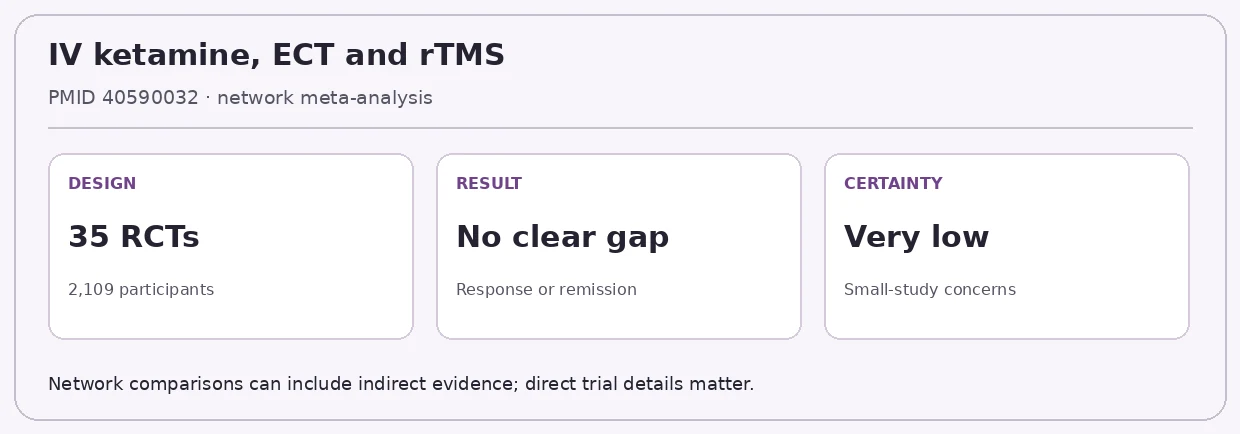
The review included 35 RCTs with 2,109 participants. It used random-effects network meta-analyses to compare antidepressant efficacy, tolerability, and acceptability. Network meta-analysis allows indirect comparisons between treatments that may not have been directly compared in head-to-head trials, but it relies on assumptions about how treatments connect across studies.
For the main outcomes, the review found no statistically clear difference in response rate, remission rate, or tolerability among the three treatments. For example, Table 1's response comparison puts IV ketamine in the row and ECT in the column: OR 0.73 (95% CI 0.32–1.69). In that table's convention, values below one favor the row treatment for response, but this wide interval crosses one. It does not establish a difference or equivalence. Intravenous ketamine ranked higher on the review's “acceptability” outcome, which meant discontinuation for any reason, not patients' stated preference. Confidence in the efficacy, tolerability, and acceptability evidence was rated very low.
Most trials raised some risk-of-bias concern. One large trial was rated high risk because of drop-out and concerns about masking of treatment allocation. Many studies were small, and small-study effects may distort the network comparison. The full text supplies comparison-specific intervals and risk-of-bias detail that the abstract omits. These findings are too uncertain to promise one treatment's superiority.
A useful interpretive question is whether a direct comparison would tell the same story as this network of trials; the abstract does not give the number of direct head-to-head comparisons. The review authors call for further large-scale studies to strengthen the findings.
Review: PMID 40590032 · DOI 10.1002/pcn5.70136
Full text: https://pmc.ncbi.nlm.nih.gov/articles/PMC12206548/
Написать Join — чтобы участвовать в обсуждении.