
A 2025 systematic review and meta-analysis asked whether community overdose education and naloxone distribution (OEND) programs reduce opioid overdose deaths. The authors searched several databases for peer-reviewed studies published 2003–2018 (Group 1) and later added studies from 2018–2022 (Group 2), when fentanyl-related deaths rose.
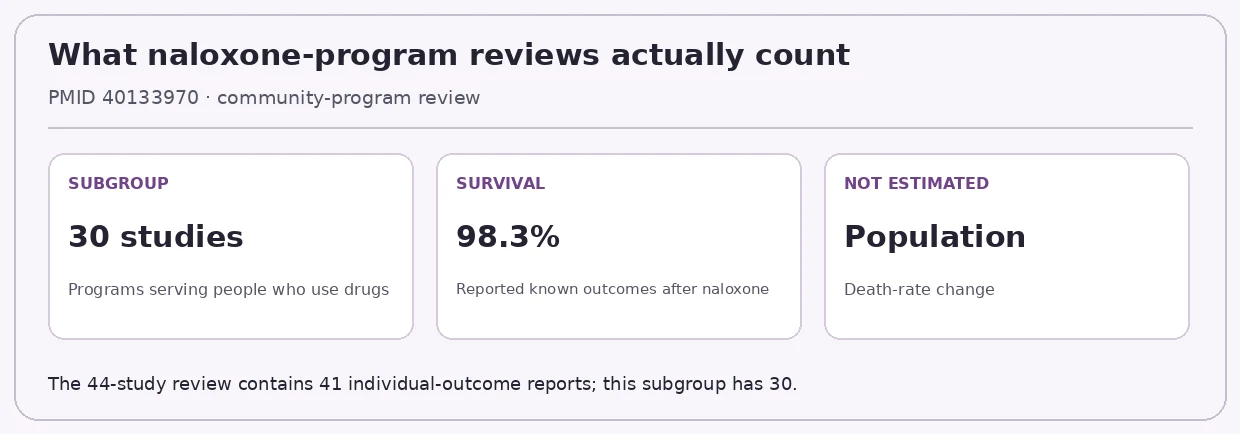
The main outcome was survival immediately following naloxone administration, not deaths averted in a whole population. Group 1 contained 44 studies; 41 reported individual-level outcomes, covering 74,114 participants and 10,328 naloxone administrations with known outcomes. The 98.3% pooled survival estimate (95% CI 97.5–98.8) came from 30 studies of programs serving people who use drugs, not all 44 studies. Other settings gave 95.0% (95% CI 91.4–97.1) for family or other community members and 92.4% (95% CI 88.9–94.8) for police. In Group 2, nine studies met criteria and five entered quantitative analysis, with similar findings.
This is a review of observational program evaluations, not randomized trials. Among 18 studies using passive follow-up, the median share of participants with follow-up data was 10.5%, compared with 74.5% in 12 studies scheduling follow-up. Also, 10 of the 41 individual-level reports omitted some denominators. The newer Group 2 studies were not formally quality-assessed. Missing outcomes could shift the measured survival proportion. Survival after a reported administration is not the same as fewer overdose deaths across a community, and these data cannot isolate a causal population effect.
A useful question is how completely administrations, overdoses, and deaths were counted. The authors argue for community distribution, but this pooled survival proportion alone cannot measure a change in population mortality.
Review: PMID 40133970 · DOI 10.1186/s12889-025-22210-8
Full text: https://pmc.ncbi.nlm.nih.gov/articles/PMC11934755/
Написать Join — чтобы участвовать в обсуждении.