Technology Overview:
Researchers at Victoria University’s School of Engineering and Science in the Faculty of Health,
Engineering and Science, led by Associate Professor Andrew Smallridge and Associate Professor
Maurice Trewhella, have developed an innovative two stage process for the manufacture of ephedrine
using supercritical carbon dioxide. The process has potential application across a broad range of
products. This patented technology uses less energy, produces less waste, and is expected to deliver
substantial cost savings compared to existing manufacturing processes, thereby addressing many of
the political and regulatory issues associated with reducing carbon emissions. A brief summary of the
process is described below:
Stage 1.
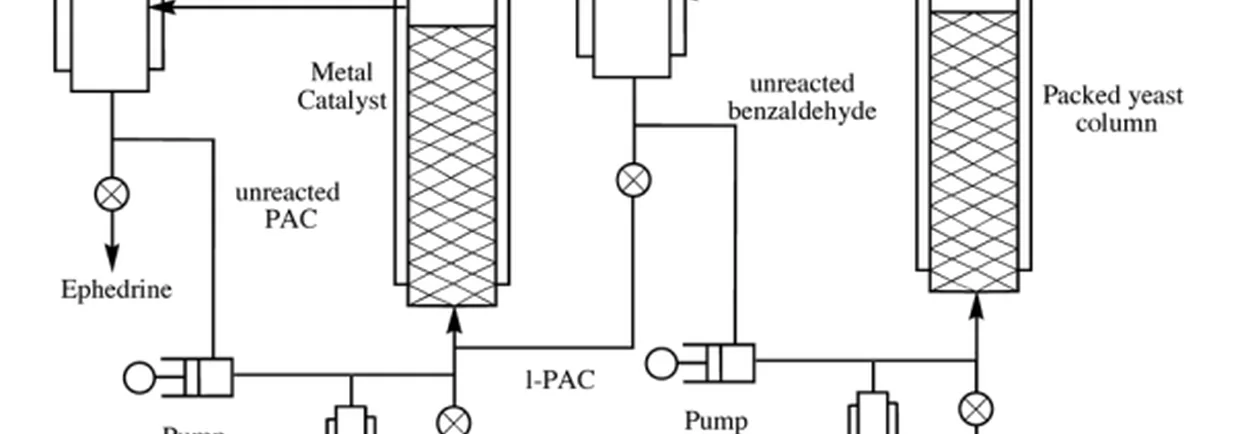
Benzaldehyde and pyruvic acid are condensed to form l-phenylacetylcarbinol (l-PAC) in supercritical
carbon dioxide (SC-CO 2) through a column of solid bakers’ yeast. Manipulation of temperature and
pressure allows pure product to be separated from the reaction mixture and then passed to a
second reactor.
Stage 2.
In the second reactor SC-CO 2 is again employed as the medium, and l-PAC is reacted with
hydrogen and methylamine over a metal catalyst to yield ephedrine. Manipulation of temperature
and pressure enables pure ephedrine to be isolated.
State of Development:
Compared to traditional methods of manufacturing ephedrine, this patented process does not involve
any fermentation: there is no requirement for large scale fermenters, sterile conditions, high-shear
mixing or nutrient dosing. No organic solvents are required for isolation or purification of l-PAC or
ephedrine.
In contrast with fermentation, which is a batch process that usually takes days to produce a single
batch, the Victoria University process, achieves high conversions in just a few hours and has the potential to be continuous. The benzyl alcohol, which is produced as an unwanted by-product of the first
stage of the traditional process is all but eliminated in the Victoria University process with insignificant
amounts being generated.
Stage 1 of the patented process has been proven at laboratory scale (100 mg) and at pilot scale (200 g),
while Stage 2 has been proven at laboratory scale and can be readily scaled up.
Victoria University has a large range of supercritical fluid equipment, including small-scale reactors and
extractors, a supercritical NMR spectrometer, and access to a pilot plant facility. Our lead researchers
each have more than twelve years experience working with supercritical systems.
Источник: http://bbzzzsvqcrqtki6umym6itiixfhni37ybtt7mkbjyxn2pgllzxf2qgyd.onion/threads/clean-green-ephedrine-manufacturing-process.410/

Написать Join — чтобы участвовать в обсуждении.