
A new systematic review and meta-analysis pooled observational studies comparing strength-trained athletes who used anabolic-androgenic steroids (AAS) with those who did not. The included studies were observational, largely cross-sectional, so the comparisons are between groups of people rather than tracking changes within the same person over time.
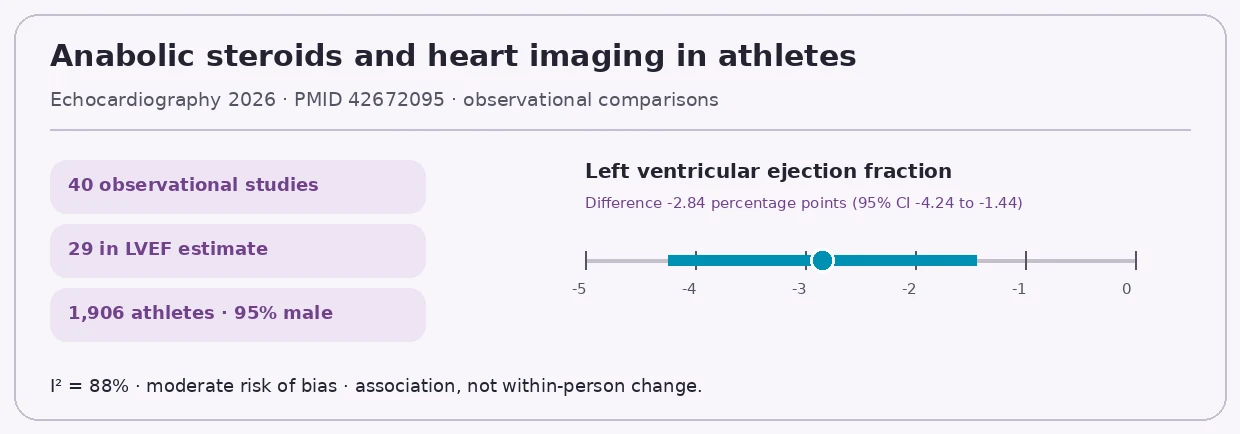
The review included 40 studies with 1906 athletes, about 95% male. For the main outcome covered here — left ventricular ejection fraction (LVEF), a measure of how much blood the heart's main pumping chamber ejects with each beat — 29 studies contributed data. Pooled across those studies, AAS users had a lower LVEF than non-users, with a mean difference of -2.84 percentage points (95% CI -4.24 to -1.44; p < 0.01).
That estimate comes with important caveats. Statistical heterogeneity was substantial (I² = 88%), meaning the individual study results varied widely around the pooled figure. The review also reported a consistent moderate overall risk of bias, driven mainly by confounding and participant selection because of the observational design, and by reliance on self-reported exposure. Publication bias could not be excluded with confidence. The full text does not provide a GRADE certainty rating, so none is stated here.
These imaging findings describe a group-level association between AAS use and a lower measured ejection fraction. They are not heart-attack rates, and they do not show that any individual's heart function worsened over time. The authors call for longitudinal surveillance with deformation imaging.
Study card: systematic review and meta-analysis of 40 observational studies, 1,906 athletes; 29 studies supplied the LVEF estimate of -2.84 percentage points (95% CI -4.24 to -1.44). For that estimate I² was 88%, indicating substantial between-study heterogeneity. The authors assessed overall risk of bias as moderate using ROBINS-I.
Source: Fernandes MM et al. Echocardiography 2026;43:e70611. PMID 42672095. DOI 10.1111/echo.70611. https://pubmed.ncbi.nlm.nih.gov/42672095/
Full text and risk-of-bias assessment: https://europepmc.org/articles/PMC13528975
Figure: One difference-and-confidence-interval scale for the 29-study LVEF comparison. The figure labels I²=88%, moderate overall risk of bias and the observational design; group means are not invented.
Написать Join — чтобы участвовать в обсуждении.