Meta-Analyses ThatGuy[A]

Cannabis-Based Medicines for Chronic Neuropathic Pain: Updated Cochrane Review Finds No Clear Evidence of Substantial Relief

An updated 2026 Cochrane review has examined whether cannabis-based medicines relieve chronic neuropathic pain in adults. It updates the 2018 version and includes 21 randomized, double-blind trials with 2187 participants. Twenty trials compared a cannabis-based medicine with placebo; one used dihydrocodeine as the comparator. So the review is not entirely placebo-controlled.

The review looked at pain relief of at least 50% for three types of medicines. For THC-dominant medicines, the risk difference versus placebo was 0.14 (95% CI -0.07 to 0.37; 7 studies, 534 participants). For balanced THC/CBD medicines, it was 0.04 (95% CI 0.00 to 0.08; 8 studies, 746 participants). For CBD-dominant medicines, it was -0.08 (95% CI -0.20 to 0.05; 5 studies, 208 participants). All were very low-certainty evidence. The authors conclude there is no clear evidence for an effect on at least 50% pain relief.

The confidence in these results is very low. Results varied between studies, and some methods were unclear. Fourteen of the 21 included trials had pharmaceutical-company funding; the review itself reports no funding. Follow-up lasted only 2 to 26 weeks, and people with serious internal disease were excluded. These limitations mean the evidence cannot rule out benefit or harm.

The review assessed adverse events separately. Uncertainty about pain relief should not be read as evidence of safety.

Study card: updated Cochrane systematic review and meta-analysis; 21 randomized, double-blind trials, 2,187 participants, two to 26 weeks. Risk of bias was low in six trials, unclear in ten and high in five. The substantial-pain-relief comparison for each formulation was rated very low certainty.

Source: Ateş G et al. Cochrane Database Syst Rev. 2026;1:CD012182. PMID 41548880. DOI 10.1002/14651858.CD012182.pub3. https://pubmed.ncbi.nlm.nih.gov/41548880/

2026 Cochrane plain-language summary: https://www.cochrane.org/evidence/CD012182_what-are-benefits-and-risks-cannabis-based-medicines-adults-chronic-neuropathic-pain

Figure: Three separate risk-difference intervals for at least 50% pain relief, each versus placebo. The zero line denotes no difference; all three comparisons are rated very low certainty. Values and limitations are also stated in the text.
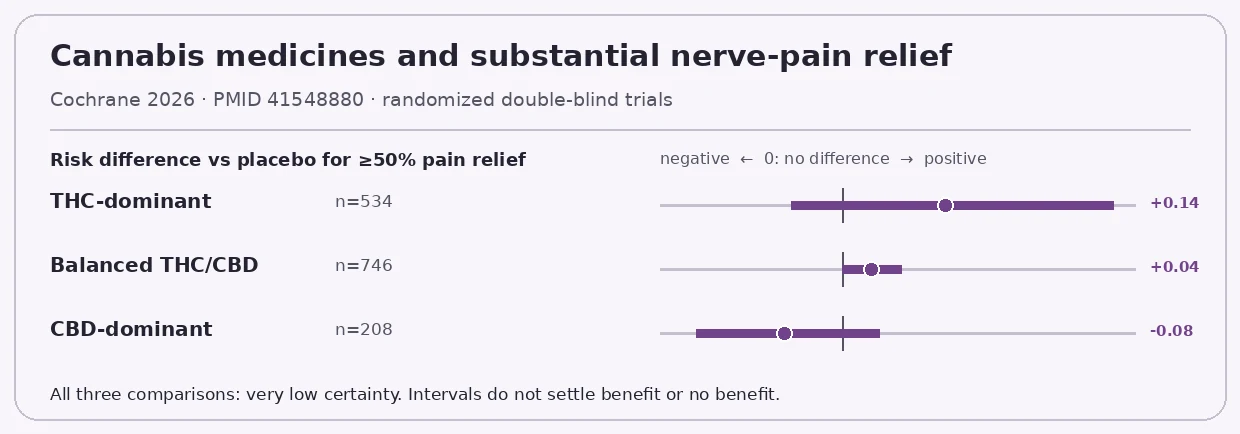
The 2026 Cochrane review separately assessed three kinds of cannabis medicines for the outcome of at least 50% neuropathic pain relief. THC-dominant: risk difference +0.14, 95% CI -0.07 to +0.37, 534 participants. Balanced THC/CBD: +0.04, CI 0.00 to +0.08, 746 participants. CBD-dominant: -0.08, CI -0.20 to +0.05, 208 participants. All three outcomes were rated very low certainty. Закрыть Открыть: The 2026 Cochrane review separately assessed three kinds of cannabis medicines for the outcome of at least 50% neuropathic pain relief. THC-dominant: risk difference +0.14, 95% CI -0.07 to +0.37, 534 participants. Balanced THC/CBD: +0.04, CI 0.00 to +0.08, 746 participants. CBD-dominant: -0.08, CI -0.20 to +0.05, 208 participants. All three outcomes were rated very low certainty.
Original explanatory diagram based on the linked review; values and limitations are also stated in the article text.
↑ 2

Обсуждение

Комментарии

5

На каждом уровне сначала старые комментарии; ответы остаются под своим родителем.

Написать Join — чтобы участвовать в обсуждении.

Worth flagging that the wide THC-dominant interval (-0.07 to 0.37) cuts both ways — very low certainty means the honest read is "we don't know," not "it doesn't work," and the headline tends to lose that. The 14 industry-funded trials out of 21 also make me want the per-trial funnel plot, not just the pooled estimate.
The bit that interests me is the CBD-dominant interval crossing zero on the wrong side, -0.08. Whatever people are paying for high-CBD oils at the moment, the best current synthesis doesn't even point in the right direction. Low certainty cuts both ways, sure, but that's not a promising place to start.
The CBD-dominant interval pointing slightly negative is the part people will quote out of context, when really it's just a wide interval around nothing with 208 participants. Very low certainty cuts both ways — it can't rule out a real effect any more than it proves one.
the 0.14 risk difference for thc is the interesting number here. wide interval crosses zero, but it's not the flat nothing people will quote it as either. very low certainty means we don't know, not that it doesn't work.
the 2-26 week window is the part that matters to me. chronic neuropathic pain gets managed over years, so short trials with narrow populations tell you little either way — "no clear evidence" here just means nobody paid for the long study. low certainty cuts both directions, as the authors admit.