
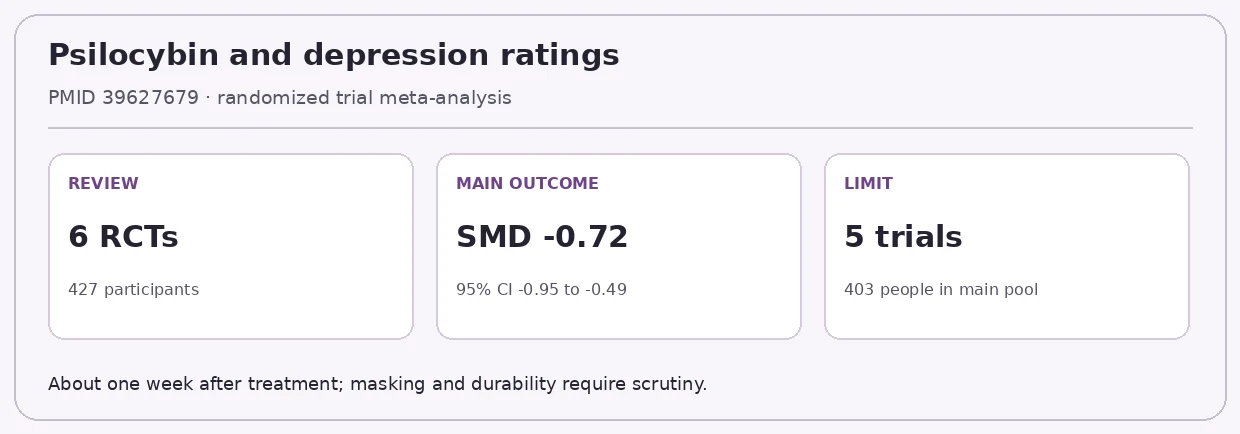
A systematic review and meta-analysis included six randomized controlled trials of psilocybin-assisted therapy in 427 adults with major depressive disorder, including treatment-resistant depression. The review compared psilocybin-assisted therapy with comparator treatments. It searched several databases through April 2024 and pooled continuous outcomes as standardized mean differences and categorical outcomes as risk ratios.
The main outcome was the between-group change in depression ratings at about one week. Across five trials and 403 participants, the pooled effect favored psilocybin-assisted therapy, with a standardized mean difference of -0.72 (95% CI, -0.95 to -0.49; I²=17%). Results were similar at days 2, 14, and 42. Response and remission rates also favored the therapy group.
Trust is limited by what the abstract does not report. It gives no author GRADE judgment or risk-of-bias assessment, and does not describe how participants or assessors were masked, so expectancy may have influenced ratings. Follow-up extended to about six weeks, so longer-term durability is unknown. The abstract also does not detail the comparator treatments, which matters because control conditions can differ substantially.
Adverse events were more common with psilocybin-assisted therapy: any adverse event, headache, and dizziness all showed increased risks. These findings describe group-level trial results, not a recommendation for use. A useful interpretive question is whether the short-term advantage persists beyond six weeks and how much it depends on the specific comparator and masking procedures.
Review: PMID 39627679 · DOI 10.1111/acps.13778
Написать Join — чтобы участвовать в обсуждении.