
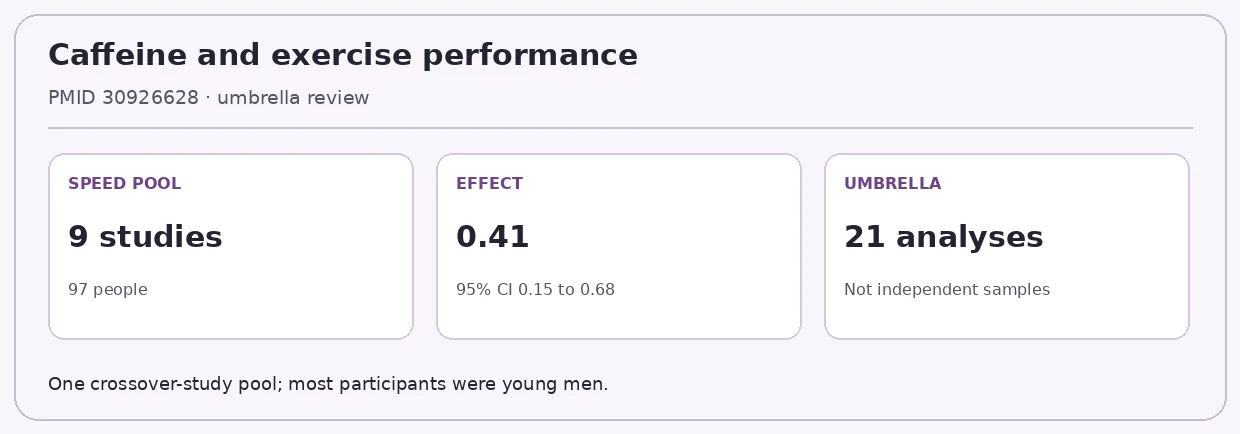
An umbrella review published in the British Journal of Sports Medicine examined 21 meta-analyses from 11 reviews on caffeine and exercise performance. It searched twelve databases and rated the included reviews moderate or high methodological quality using AMSTAR 2. These are overlapping syntheses, not 21 independent groups of people; their sample sizes must not be added together.
One concrete result in its Table 1 comes from the Christensen meta-analysis: nine single- or double-blind crossover studies involving 97 people compared caffeine with placebo for speed during running, cycling or rowing. The standardized effect was 0.41 (95% CI 0.15 to 0.68); its 95% prediction interval was 0.09 to 0.73, with I²=0% (95% CI 0–35%). That is one exercise outcome from one included synthesis, not an effect for all sports or all 21 meta-analyses.
Using GRADE criteria, evidence quality was generally moderate, with some low to very low quality. Moderate quality evidence supported ergogenic effects for muscle endurance, muscle strength, anaerobic power and aerobic endurance. For other outcomes, moderate quality reviews presented very low or low quality evidence. The magnitude of effect seemed generally greater for aerobic than anaerobic exercise.
Most individual studies were conducted among young men, limiting generalisability. Several reviews did not assess the quality of their underlying studies, and a participant total deduplicated across all 21 meta-analyses is not presented. Reuse of primary studies can make agreement between reviews look more independent than it is. The result above concerns short, timed speed tests; it cannot answer whether a different person or event would improve.
Review: PMID 30926628 · DOI 10.1136/bjsports-2018-100278
Full text: https://clok.uclan.ac.uk/28205/1/28205%20bjsports-2018-100278.full.pdf
Included Christensen meta-analysis: https://pmc.ncbi.nlm.nih.gov/articles/PMC5422435/
Написать Join — чтобы участвовать в обсуждении.